How to Make Your Own Plastic Ring
Although there is a resurgence in the use of plastic resin in modern jewelry, plastic has been a fixture in art jewelry since the late 1800s when it began to make an appearance as a substitute for rare and expensive materials. This tutorial lets you master a few simple techniques and design your own plastic ring masterpiece. Depending on the images and colors you choose for your ring, you can make go from sassy to serious and from elegant to everyday. Wear your new ring out on the town or to the grocery store. Your friends will be impressed with both your creative design and the economical price.
- Difficulty:
- Moderately Easy
Instructions
Things You'll Need
- Epoxy resin
- Plastic cup
- Wooden stick
- Mold
- Fabric, photograph or image
- 10 to 14 gauge round wire
- Ring mandrel
- Wire cutters
- Pliers
- File
- Craft knife
-
-
1
Select your mold. Molds come in various shapes and sizes, so you can make your ring as large as you like.
-
2
Prepare the mold with a release agent to prevent the epoxy resin from sticking to the mold.
-
3
Mix the clear epoxy resin according to the manufacturer's instructions using a disposable measuring cup and a craft stick or coffee stirrer. To avoid unsightly bubbles, take care to not over-mix.
-
4
Pour the resin into the mold until the mold is about a third full. Let the resin harden overnight or according to manufacturer's instructions.
-
5
Find a copyright free image, photograph or fabric to insert in the resin. If the image is paper, print it out on glossy photographic paper. Cut to the shape of the mold.
-
6
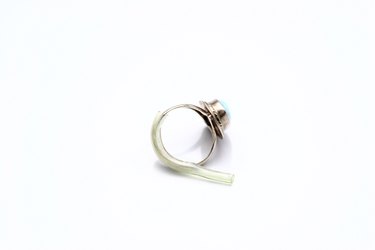
Create a ring shank by cutting 10 to 14 gauge round wire and forming the wire using a ring mandrel in the shape a pinched "U." You can use sterling silver, brass or copper in your design. Cut the wire to the desired ring size using the wire cutters. Be sure to leave the ends of the pinched "U" at least 1/4 inch long, so they will sink into the resin. Pinch in the ends of the wire with pliers to create a ring that will fit you comfortably and will leave feet to sink into the uncured resin.
-
7
File the ends of the wire smooth.
-
8
Place the copyright free photograph, fabric or paper onto the hardened resin once it has set. Trim as needed. Place the prepared rink shank so that the ends sit flush against the back of the decorative paper and the ring shank is in the air. Secure the ring shank with tweezers to be sure it does not move and will set into the new resin properly.
-
9
Mix a fresh batch of resin and pour the resin into the mold, being careful to not over-fill or under-fill. The feet of the ring shank should sit securely in the fresh batch of resin. Note that this second batch of resin need not be clear.
-
10
Let the resin harden overnight or according to the manufacturer's instructions. Be sure the ring shank is buried at least 1/4 inch in the new layer of resin. Once the resin has set, remove any excess resin by sanding, filing and polishing the ring.
-
1
Tips & Warnings
Cover your work area completely with waxed paper before you begin this project. Epoxy can be difficult to remove from some surfaces, but it will not stick to waxed paper.
There are a number of commercial molds on the market, but it is not difficult to make your own mold from a number of materials including polymer clay and cold mold compound.
Epoxy resin can be purchased in the hardware store in long-curing and quick-curing versions. A long-curing epoxy is easier to work with, as it gives you more time to change or add elements before it sets.
Be aware that while the cheaper resin is a lot less expensive than jewelry grade products, it also has a tendency to yellow over time.
The colors of jewelry grade epoxy resin tend to stay true; however, jewelry grade resin needs to be measured and mixed with precision or it will not cure. Hardware store epoxy is more forgiving with imprecise mixtures.
Many household items can be added to resin to give it color or sparkle. Add a bit of eye shadow, pixie dust or glitter to the second layer of epoxy to give your ring a different look.
If your resin has bubbles on the surface, use a toothpick to lightly pop them.
Epoxy pigments are also available, and allow you to add color to your projects.
Do not touch the resin to test if it has hardened. Uncured resin will retain your fingerprint on the surface of the piece. If you want to be sure, leave your resin alone for at least 24 hours.
Remember that resin is a chemical. Work in a properly ventilated room and use a respirator, gloves and safety goggles when working with resin. Always read the Material Safety Data Sheet (MSDS) provided by the manufacturer before working with any epoxy resin product.
Resins are flammable so be sure to keep all resin away from electrical equipment or open flames.
Do not work with epoxy resin if you are pregnant.
Wear latex, vinyl or nitrile gloves when working with epoxy resin.
Related Searches
References
- Photo Credit Dynamic Graphics Group/Dynamic Graphics Group/Getty Images