How to Dye Clothing Very Bright

By robertsloan2

Dye Clothing Bright Colors Dye Clothing Bright Colors

Rate: (15 Ratings)

There are many products available for dyeing cloth, most of them involve a dye and also a fixing agent or mordant. They are expensive, complicated and sophisticated craft items that can be very satisfying to an experienced crafter. But there is an easier way to get good bright colors if you're just a dabbler trying to make a cool tye-dyed t-shirt or get an old sheet bright green for a Christmas backdrop!

Instructions

Difficulty: Moderately Easy

Things You’ll Need:

  • Tube acrylic paints, in transparent colors, the bright colors you want.
  • Cotton string or thin rope for tying if you want to tie-dye
  • Large bucket with a lid.
  • Water
  • Clothing you want to dye.
  • Rubber gloves if you use any pigments that are labeled toxic. Don't worry about it with non-toxic hues, acrylic paint washes right off with soap and water.

Step1
Decide what colors you want and whether you're going to do a pattern, solidly dye it or do a gradient. You can do any of those things with this method, and I will include how to do overdyeing and gradients with this simple method. I learned this from an artist in New Orleans who was wearing a brilliant blue tie-dyed t-shirt that he'd done himself -- and what he used was his artist paints. He created it by thinning Pthalo Blue tube acrylics to the texture of ink, tying off the shirt for tie-dyeing, dipping it in the cold-water mixture and letting it dry. Then he washed it, and the colors remained bright through dozens of washings.

That is the gist of the method -- using tube acrylic paints thinned with water till they're like ink. You don't need fixing agents, you don't need hot water or to stain your washing machine, just rinse it thoroughly when you're done so that extra paint doesn't get in the washer.

Look for colors that are transparent. Often artist tubes of paint will tell you on the label whether they are transparent, translucent or opaque. Pthalo Blue, Pthalo Green, Dioxazine Violet, Alizarin Crimson are all very transparent colors. If you do painting, you'll know by swiping the paint on a canvas and seeing through it to the texture or a line underneath.

To get a deep true black it may take several dippings in black thinned-acrylic because Ivory Black is transparent, but it will be lasting and very brilliant when you are done. Overdye with deep purple and dark brown for a rich black, or deep blue and dark brown and black together for a jazzier black.
Step2
Put a bit of paint in a bucket of water and stir it. Remember how when painting, the water you rinse the brushes in turns a bright color? That's what you're going for -- a solution of paint that's transparent but shows the color. For a flat color, be sure not to roll, twist or tie the garment. Put it in, swish it around, make sure it's thoroughly soaked everywhere, pull it out and let it hang dry. Rinse after it's hang dried. If it's too light, put it in the acrylic-paint dye bucket again and overdye it till it's dark enough to suit you.

Don't throw the bucket of paint-water away till you're done dyeing your first project. It's still usable because the water keeps the acrylic from drying out. Where it dries on the sides it will form a thin plastic film that peels right up. This is the key to why it doesn't come out in the dryer -- that film forms on the fibers of the garment. Use a bucket with a cover so that you can keep it for the next use.
Step3
Dye ombre yarn with shorter bands at the ends. Fold in the middle if the middle color shouldn't dye the ends. To dye a sheet or garment in a gradient, lighter at one end and darker at the other, mix your color or colors. Do a very thin rinse of the color for the lightest part, then do a slightly darker and darker one. You can do this with successive colors like yellow > green > blue-green too, mix thin yellow, light yellow green in the next bucket, bright yellow green in the next, emerald green in the next, turquoise in the next and Pthalo Blue in the last, which will go over the yellow pretty well. Test your colors on paper or canvas to see how they go over each other, that's the gradient you will get doing this. Yellow > orange > red works well this way too, as does lighter and darker shades of any color.

You can make ombre yarn out of white yarn by this method. Roll it so that it's in a very long loop, then dip most of it or all of it in the lightest color, drip, dip in the next darkest but not as far, and so on. Make the part at the ends half the width of the bands in the middle so that the bands are even, or make some bands wider and others shorter for a fun variation. Dry and rinse in clean water, re-roll into a ball or on a yarn winder.

Permanent Rose is a good bright purple or fuchsia depending on how strong and it can mix with Dioxazine Violet for red-violets. But the best hot pink is called Opera Rose from Winsor & Newton -- it is truly a neon bright hot pink and will make a neon hot bright orange used with Lemon Yellow or Transparent Yellow.
Step4
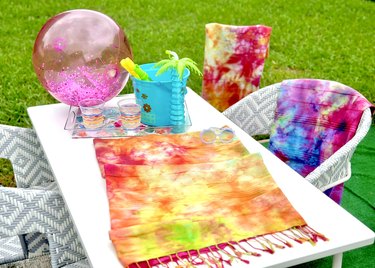
Tie dyeing in successive overlapping colors For tie-dyeing, the process is pretty much the same as doing a gradient. Go ahead and dip in the next pots while it's wet. Dye it in the lightest color first, tying it to get white streaks and circles. Bundling your t-shirt longwise makes stripes, bundling it in circular patterns is done by pulling up a bit and wrapping a rubber band around it, then more rubber bands along the part you grabbed. You can get many special effects with where and how you bunch it and put rubber bands.

Dye the lightest color first, let it dry, wash it, see how it looks. Then tie it up again and do the next color. Repeat till it looks the way you want it to. If you want colors that do not work well with yellow or other colors under them, don't dip those parts of the garment. It takes a little ingenuity to overlap blue and yellow to get clean blue with purple on one side and green on the other, but it can be done if you just figure it out and dry and rinse it between dippings.

Again, on all these projects, squish it in the liquid and make sure it soaks well. Do not make the liquid too thick, or it will become stiff. The reason it doesn't stiffen the cloth is that it's mostly water with very little paint, it has ink consistency or even thinned ink consistency.

This is as easy as getting punk hair coloring by using Kool-aid to dye your hair. It's a little more expensive to use art supplies, but the results are spectacular and last through many washings.

For batik effects, drip melted wax or paraffin for a resist before dyeing. Resists will work on this method as well as with the more sophisticated dyeing methods. Rinse in hot water to melt and remove the wax afterward.
Step5
One of the fanciest effects you can get is mixing up thinned acrylic at ink consistency, using a brush and painting on your clothing. If you're good at watercolors, you can add details without soaking the entire garment after the basic dyeing is done.

Tube acrylics can also be substituted for fabric paint that comes in bottles, but try not to use thick applications or they will get stiff as fabric paint does. Use the least paint you can for the effect you want, and you'll have a spectacular piece of wearable art!

Tips & Warnings

  • Before dyeing any garment with this method, try the mixture on a scrap like an old pillowcase or a bit of the fabric. Sometimes different fabrics soak more of the color than others, so if you have any scraps of similar material you can save yourself a lot of trouble.
  • If in doubt, go lighter because you can always repeat the process to get it darker, but getting acrylic paint as dye out is nearly impossible.
  • Rinse thoroughly after it's dried, so that any loose paint does not stiffen the fabric. Work it with your fingers till it's no longer stiff if you find any stiff patches, those may have been chunks of paint that didn't get thoroughly mixed in.
  • Synthetic brushes work best with acrylics if you're painting, organic fibers soak the paint in and get dyed just the way your clothes do. Some synthetics stain too. Any staining color that turns your paintbrush blue or pink is a good candidate for dyeing your clothes bright colors!
  • Be careful when handling toxic pigments. Artist grade acrylic paints sometimes carry a CA prop 65 label, this means the pigment is toxic. Do not suck the brushes, do not get it on your mouth, try to keep it off your hands by using rubber or latex or surgical gloves while dyeing. Dispose of the material carefully keeping in mind that it is toxic. Soak up the remaining dye-water with rags or paper towels when washing out the bucket, then dispose of them as toxic when you're recycling. Acrylic paint does not carry dangerous fumes though, so handling isn't as difficult as with some mediums or dyes.

Comments

| View All Comments
AbbyNormal

AbbyNormal said

Flag This Comment

on 6/4/2008 Excellent article.

GlindaLupo

GlindaLupo said

Flag This Comment

on 2/16/2008 This sounds really neat! I do paint and dye fabrics when I am designing clothing and quilts. I am going to try this method...sounds fun! If you use non-toxic paints, this would be a fun activity to do with children. Nicely written article!
-Glinda :D

Flag This Comment

on 2/12/2008 I have a 40% wool/ 40% polyester jacket that is quite long. I'd like to spice it up - found it at my local thrift store for 99 cents. Its a dark grey, very boring.. can I use this method for dying? Any tips - since it's such a large garment?

Flag This Comment

on 12/18/2007 I've always wanted to try dying fabrics - I'll be printing this how to out for when I'm ready. Thank you! :)

Flag This Comment

on 12/2/2007 The handle's not too bad, just wipe it clean. These colors are pretty strong, so if you have anything but a black handle on your brush, you can see it. You might want to stick to non-toxic hues if you have that habit, it's easier than worrying about it. They are sometimes brighter than the traditional pigments!

View All

Post a Comment

POST A COMMENT

Request a New How-To Article

Looking for more How To information? Chances are there’s an eHow member who knows how to do what you’re looking to do. Submit an article request now!

eHow Article: How to Dye Clothing Very Bright

eHow Member: robertsloan2

robertsloan2

Authority Authority | 12273 Points

Category: Hobbies, Games & Toys

Articles: See my other articles

Related Ads

Hobbies, Games & Toys

Sentigen
Meet Nate Chang, eHow Expert eHow’s Hobbies, Games & Toys Expert.