Things You'll Need:
- Buff color velour board or paper
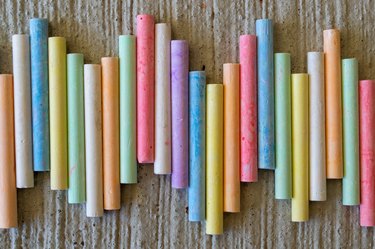
- 48 color set of colored Conte crayons
- Kneaded eraser
- Pencil
- Photo reference of a small, bright colored bird
- Optional tracing paper and graphite transfer sheet to transfer sketch
-
Step 1
Sketch of Indigo Bunting, branch and logMark off a 6" square on a piece of buff colored velour paper or board. I used a 2B pencil to create strong lines because the bird is fairly dark and they'll vanish under the drawing. I marked the lines of the branches lighter but they can still be seen. Look ahead to later stages for the shapes of the branch the bird's on and the angled peeling log in the background.
These elements help balance the composition. The beak of the bird is a focal point, it's got a black upper beak and a white underbeak, so it has the most contrast of anything in the picture. It's located at one of four important points in the square composition, based on the Rule of Thirds.
Divide your picture area into thirds in both directions. The four intersections are each points of interest that help balance a drawing or painting to give it a more pleasing look than placing something dead center either horizontally or vertically. With a square painting, it's possible to use the center as a focal point too, but only if the design radiates outward in four or eight directions like a mandala. Most artworks suffer if the horizon line or the most important element falls central either vertically or horizontally.
Other composition points. Avoid "kissing." Don't place any element like the tip of a bird's tail or the end of a leaf or branch exactly at the edge of the picture area, because that leads the eye right out of the picture. Elements that come into the picture and leave again at an interesting angle like the branch or the log can work well. Because the bird is placed high on the picture, I added in the log to balance it and create a better shape of negative space.
Angled branches and elements like that are more lively than pure vertical or horizontal ones. -
Step 2
Indigo Bunting, stage twoDraw in the lightest lights and darkest darks. Starting with a pale orange shade lighter than yellow, sketch bark texture on the right side of the branch the bird's on, the fork of the branch, the edge of the peel of bark and the edge of the stripped log. Add some light gray in streaks to the log, where its highlights show.
Using black, draw the bird's upper beak and eye carefully. Work around a tiny speck of white highlight in the bird's eye, leaving it blank for the moment. Use the corner of the black stick to get the narrow line around that highlight. Softly shade in some shadows where the feathers are darkest on the bird, then work down toward the shadows behind its feet, the stark deep shadows under layers of feathers, and finally the tail feathers that are almost completely black.
Use black to shadow the left side of the branch, especially where the bird's shadow falls across it but also lightly on the rest of it. Shadow and streak the stripped log as well.
This will make the entire design much more visible than the pencil sketch alone was, and make it easier to start working in multiple layers over the branch, log and bird.
Finally, use white to further highlight the highlight area intermittently, not as a solid line but occasional marks feathered off at beginning and end. Keep the edges of the branch rough because the bark peels up at its cracks. -
Step 3
Indigo Bunting, stage three, base colors blocked in and eye/beak details doneBlock in the main colors of the bird, using successively lighter shades of cold (greenish) blue from the darkest bright blue up through aqua and the lightest blue over that for highlights. Use strokes that go in the direction of the feathers, soft fluffy strokes where the feathers are fluffiest and narrow linear ones where feathers are distinct and edged. Follow the feather patterns carefully. There is a link at the bottom to my article here on How to Draw a Bird's Wing that should help with identifying the primaries, secondaries, coverts and lesser coverts on the visible closed wing and rendering them accurately.
Using the sharpest corner of your white crayon, put in the eye highlight that you reserved in the previous step. Then put in the white lower beak. It looks very pale in my reference though it is listed as light beige in the Audubon Society description. To make this the jazzy focal point of black against white, we'll go with the way the photo looks more than the description.
Use some brown and some light orangy tan to fill in the bark, shading darker toward the shadow. Use orangy tan to do the legs and toes, then highlight on the light side with the pale orange of the branch highlight. Run a streak of orangy tan right under the bright highlight on the edge of the curled bark roll. Then with the darkest brown, fill with long narrow strokes going in the direction of the bark. Streak some of that very dark brown in the log for wood grain, then go back with the medium brown and add more streaks. Use a little of the medium brown in the inside of the bark roll.
At this point the bird is the focal point and very bold against the background, the branch and log and bark fade too much compared to the bird. We need to do something to jazz up the background a bit. -
Step 4
Indigo Bunting, stage four, branch, bark and bare log strengthened to balance the birdStart working more grays into the faded bare texture of the log, using a little of the lightest blue to highlight it. This will help tie the bird into the background better. Go over the entire surface of the bare log with the dark gray, using the chisel end to get broad strokes, go lightly and cover the whole thing with a light layer of dark gray. Then add streaks of light gray, which is bluer, and finally some streaks of the light blue.
Use some Sanguine to model the tree bark on the main branch. Shade into the shadow of the bird with violet and blue, then go into that with dark gray to mute it. Shade into the dark side of the log with violet and then mute that with the dark sanguine. Use the orange tan over the blues if it gets too intensely blue, to mute them by mixing with a complement.
Add some charcoal and black shading to the inside of the bark, and use the darkest sanguine a little in it to give it some oolor. -
Step 5
Indigo Bunting, final stageAs you work, stand back from the drawing once in a while to ask yourself what it needs next. Sometimes it's easier to tell at a distance than right up close to it. Alternately, scan it and look at a small thumbnail of the piece to see what comes through bold and what needs more work.
I darkened the bird, going back into the wing primaries and coverts with black, then adding small soft black shadows into some of the areas where his feathers are fluffed. This bright blue bird is the male Indigo Bunting, like many other small birds his female companion is a soft pretty brown with similar markings.
First, I loosely added more background branches in brown, with fewer contrasts of value and less detail. Then, deciding the buff background just wasn't working, I filled in around them with the light gray in a smooth overcast-day sky color, and signed in the light blue on the bark of the background tree. After scanning, I strengthened the highlights on the stripped log and detailed my signature with turquoise and white to make it a little more prominent.
Looking at a scan of the art on the preview screen has a similar effect to standing away from it at a distance, and will also show how your art will look when it's posted online. Any areas that cause problems online will reduce your ability to display the piece for friends or sell on eBay, so creating art in a way that looks good both online and off is a good thing to keep in mind. Thumbnails are a great test for overall composition.
With a detailed pastel painting like Indigo Bunting, it's easy to keep reworking it until you're completely satisfied. The beauty of velour board and paper is that you can keep altering the color, the texture, the emphasis with multiple layers and still have a beautiful strong painting afterward without creating mud. The gray sky made the log seem too cold and blue compared to the rest of the background wood, so I brought more light orange and tan into the sunlit edge to unite it with the rest of the background elements.
Velour paper is a trick many pastelists have used especially for nature art for years. Your work is worth giving it the very best materials--and velour paper is one example of why sometimes the best materials actually produce better results impossible with any other surface.