How to Turn Broken Ceramics Into Art
Crash! Your heirloom vase just took a dive and is now resting in pieces. The end. Or is it just the beginning? With a folk craft known as "pique assiette," or shard art, you can give the pieces new life as a mosaic picture frame, flowerpot, tabletop or whatever you can dream up.
- Difficulty:
- Moderately Easy
Instructions
Things You'll Need
- Grout Sealer
- Flowerpots
- Picture Frames
- Rags
- Tile Grout
- Rubber Gloves
- Craft Sticks
- Hammers
- Putty Knife
- Rubber Mallets
- Safety Glasses
- Tile Adhesive
- Rubber mallets
-
-
1
Look at the pieces of ceramic with a new eye: as raw material for art. Figure out how much area the pieces will cover and whether they're small enough to work with (see Tips).
-
2
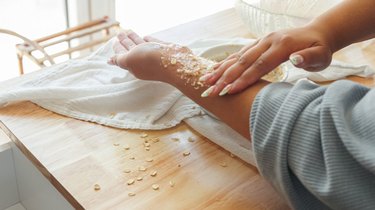
Break up bigger pieces carefully. Place them in a pillow case or old sock and tap them - not too hard, but not too softly - with a hammer. Stop when you have pieces small enough to lie flat on the surface to which you'll attach them.
-
3
Choose the object you will decorate. Consider a wide picture frame for pieces of smaller objects, a flowerpot or - if you have lots of pieces - the top of an end table.
-
4
Determine whether you have enough shards to cover the surface you've chosen. Remember that if you don't have quite enough, you can fill in with pieces of another item or even small decorative tiles.
-
5
Purchase mosaic adhesive (available in most craft stores) and tile grout in any color you like.
-
6
Create your design by placing the pieces on the surface until you've achieved a pattern you like. Remove the shards to a work surface, preserving the design while you prepare the surface and the shards.
-
7
Make sure the surface and your shards are dust-free. Apply a thin layer of mosaic adhesive to the surface to be decorated and to the backs of the larger shards, then attach the shards to the object.
-
8
Apply tile grout to the gaps between pieces with a putty knife, a craft stick or your rubber-gloved fingers. Wipe off any excess with a clean cloth. Wait for the grout to dry, and your work of art is done!
-
1
Tips & Warnings
How do you know whether your shards are small enough? It's mostly a matter of taste - what looks right to you? One consideration is to make sure they'll lie flat on a flat surface or match the curve of a rounded one. Experiment.
Choose the object to decorate carefully. Mosaic adhesives stick best to porous surfaces such as particle board. If you're decorating smooth stone or glass, attach a piece or two with mosaic adhesive to make sure they will stick.
If your object will be used to serve drinks or will otherwise encounter liquids, protect the grout with an application of grout sealer (available where tile supplies are sold).
Wear safety glasses when breaking up ceramic shards.
Be careful when handling the broken pieces, which may have sharp edges.
Related Searches
Comments
-
tshved
May 16, 2010
Good idea since I'm always breaking dishes. -
Larry Fike
May 15, 2010
How timely! I just broke my favorite coffee mug last night. I shall indeed apply your principles and create art out of catastrophe! :-) -
maxwood
May 15, 2010
continued (from below): on the disc, for less wear; (b) change location of work on the piece, which gets less hot; (c) change direction of cut (get done faster)-- sanding only the sharp edges producing a piece which is safe for children to use to put together creative structures like with wood blocks. 4. Your next toy project, of course, will be to sand (scrap salvaged) wood blocks, which are even more educational because they, once sanded (all edges and faces), exhibit the God-given grain and natural beauty. -
maxwood
May 15, 2010
1. DON'T break up slightly chipped vases etc., they're still worth something, instead go to a dump and pick up thousands of fragments, all types and colors, even glass and small stones, that have been lying there months or years, but still good after a washing. 2. To cut sharp pointy corners off a larger piece, use a "glass-cutter" (little metal thingy the length of a ballpen with a tiny diamond wheel at one end) to make a straight score line, then turn the piece over, tilt it against a surface, and rap it lightly with your hammer for a neat straight break-off. 3. Don't both cutting down all larger pieces, instead after trimming off a sharp point or two so they have 3 or more straight sides, sand each polygon on a 7" carbide disc which is mounted on a regular 1725-rpm motor shaft. Use the "C-stroke" (on the left, dust-flies-down side of the disc) to (a) change location of work... -
Zendora
May 15, 2010
This article gives me a good idea on how to use up my leftover grout, glue, and broken dishes. Thanks much! 5*'s for you!