How to Paint a Landscape With Watercolors

By eHow Arts & Entertainment Editor

Rate: (12 Ratings)

Painting outdoors is a peaceful way to enjoy a beautiful day. Keep a backpack full of painting supplies and you can be ready to go whenever the inspiration strikes.

Instructions

Difficulty: Moderate

Things You’ll Need:

  • Art Sets
  • Fan Watercolor Paintbrushes
  • Flat Watercolor Paintbrushes
  • Putty Erasers
  • Round Watercolor Paintbrushes
  • Watercolor Blocks
  • Watercolor Brush Cleaners
  • Watercolor Brush Holders
  • Watercolor Paintbrushes
  • Heavy Cardboard
  • Masking Tape
  • Facial Facial Tissues
  • Water Containers
  • Pencils
  • Watercolor Paints
  • Watercolor Paper
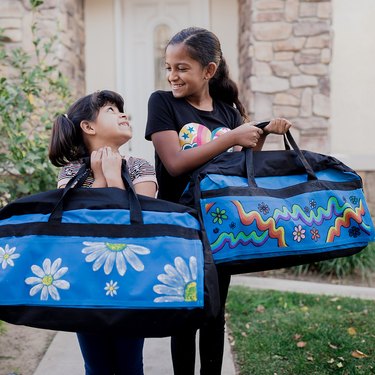
  • Backpacks

Step1
Tape a piece of watercolor paper to a heavy piece of cardboard using masking tape. Run the tape along the entire edges of all four sides of the paper.
Step2
Use a soft lead pencil to begin your painting with a simple sketch.
Step3
Locate and draw the horizon line, which is the line formed where the sky and the land meet.
Step4
Sketch in the background objects: hills, mountains, distant trees. Background objects are typically smaller and have less detail than objects in the foreground.
Step5
Sketch the objects in the foreground. These objects will be larger and more detailed.
Step6
Use clear water and a flat brush to dampen the sky area of your picture.
Step7
If you're painting on a sunny day, use a medium round brush to paint a blue sky over the sky area while the paper is damp. This is applying what is called a 'wash.'
Step8
Create clouds by blotting the sky with a crumpled tissue while the paint is still wet.
Step9
Use the same wash technique to paint in large areas of background color such as hills, mountains, water and grass.
Step10
Wait until the watercolor paper is dry or almost dry to paint details; your paintbrush should also be nearly dry. This technique, which gives you more control over the paint flow, is called 'dry brush.'
Step11
Paint in details using a small round brush. Mix paint with more water to create softer, lighter hues. Use less water to create darker, more vivid colors and harder edges.
Step12
Allow your finished painting to dry completely, then carefully peel away the masking tape from the edges of the paper. This will leave a nice white border around the edge of your painting.

Tips & Warnings

  • Consider buying a watercolor block, which is a pad of water-color paper that is glued on all four sides. A watercolor block is rigid, which makes it easy to take anywhere so you can do without a drawing board.
  • Postcard-size watercolor pads are available in many stores, and they're fun to take on trips. Friends will appreciate receiving a hand-painted landscape postcard from you.

Comments

| View All Comments
Anonymous

Anonymous said

Flag This Comment

on 11/22/2005 Place your paint in an empty, plastic egg container. You have 12 empty cells for different colors and you can mix them there too. Just throw it away when you're done.

Anonymous

Anonymous said

Flag This Comment

on 11/22/2005 Tip provided by: NYArtsAlive.com

Every landscape artist knows the feeling of coming upon a beautiful location, at a time of day when the sky and light are glowing, the light and shadows are "perfect" and wanting to kick yourself because you don't have your paints, sketchbook or camera with you! To avoid this problem, here is an idea for a small, portable watercolor painting kit you can keep in your car.

To start, locate a "Polar Pack" type of thermal lunch bag sold at your supermarket or discount store. There are two styles; you want the taller style. These lunch bags are waterproof, washable,convenient, portable, have a shoulder strap and even come with an attached waterbottle nestled in its own pouch!
Inside you can place:
1)A small watercolor "moist pan" kit or "Field kit" (Yarka and other brands have these available.)
2. Several inexpensive flat and round watercolor brushes in various sizes.
3. Small Watercolor Sketch book.
4. A mini-pack of tissues.
5. "Click" type of pencil w/eraser (never needs sharpening.)
6. Small disposable camera.

This is a simple watercolor sketching/painting kit you can have on hand in your car or carry with you when you travel. It will always be ready to help you capture the next inspirational moment...and ...you can even pack your lunch!

Anonymous

Anonymous said

Flag This Comment

on 11/22/2005 Recycle masonite as a substitute for canvases for oils or acrylics. Prime it, then go over it with gesso, or just paint directly on the primer.

Anonymous

Anonymous said

Flag This Comment

on 11/22/2005 Mix colors ahead of time. Let them dry in egg cartons. Use the top of the carton for creating color tints. When finished, throw away the used carton.

View All

Post a Comment

POST A COMMENT

Request a New How-To Article

Looking for more How To information? Chances are there’s an eHow member who knows how to do what you’re looking to do. Submit an article request now!

eHow Article:  How to Paint a Landscape With Watercolors

eHow Arts & Entertainment Editor

Related Ads