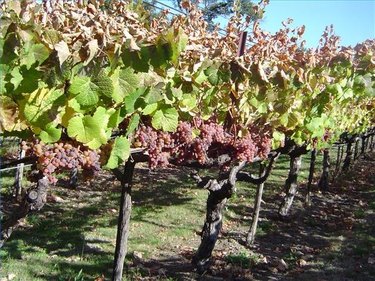
From wine to raisins to the grape juice kids drink out of sippy cups, grapes provide a large assortment of foodstuffs, beverages and other products. Over 600 different types of grapes exist around the world. Some, like Chardonnay and Cabernet Sauvignon, are used only for wine production, while others, like Concord and Thompson seedless grapes, are made into nonalcoholic juice and are favorites for healthy snacks. Most types of grapes require severe pruning at the end of their growing season in the fall. They even appear dead during the winter, but just wait until spring, and you will be able to witness their rapid growth firsthand.
History
Video of the Day
Grapes have been popular since humans first discovered their plump juiciness in the Black Sea area of Eastern Europe. It is believed they are native to this region and that early humans ate them during their hunting and gathering forays before the development of agriculture. Grapes might have been one of the first crops that humans purposely cultivated, and they traveled quickly to other parts of the world because of their nutrition, good taste and suitability for making into alcoholic beverages such as wine and brandy. From the earliest historical records, historians and archaeologists have found grapes mentioned as long ago as 6000 B.C. In ancient Greece and Rome, winemaking was perfected and the god Dionysus or Bacchus became the "god of the vine." Many different varieties of grapes have been hybridized and cultivated since the early days of Greek and Rome, many of them having specific purposes, such as those appropriate for making raisins, as well as those that are prized for different types of wine. When pasteurization become common in the 1860s, Dr. Thomas Bramwell Welch began the grape juice industry that remains today.
Video of the Day
Types of Grapes
The best types of grapes to grow at home depend on what you like and what you want to use them for. You might consider Concord, Flame seedless or Thompson seedless for the best eating grapes. Wine grapes are a little trickier and require more specific environmental conditions, but if you live in an area such as inland Northern California, you're already in wine country, so choose a Chardonnay or Zinfandel vine if you want to try your hand at winemaking. Even if you live inland in places such as Phoenix, Arizona, you can grow some types of grapes, such as Flame seedless. The choices of varieties are wide, but remember that wine grapes are not as good for eating as the varieties that have been bred for that purpose. Local nurseries carry several types of bare root grapevines in the winter and spring months. Check with them to find a variety that is recommended for your region.
How to Grow Grapes
You can grow a grapevine or two in your backyard if you have full sun and live in an area where the winters don't get too cold. Your county extension service can recommend varieties that are best for your locale. One grapevine is capable of producing as many as 25 or 30 pounds of grapes each season, so you'd better like grapes if you plan to grow even one vine. Plant grapes in an area with a southern exposure because they need plenty of heat. Also make sure the planting area has deep, well-drained soil that contains plenty of organic matter---grapes do not thrive in clay or sandy soils. The pH of your soil should be between 5.0 and 5.5. You can maintain those numbers by spreading a mulch of pine or fir needles. Water your grapevine from below during the summer because moisture on the developing fruit can cause bunch rot and fungal diseases. These vines respond well to the same frequency of watering that you give your lawn---deeply once per week and more often during extremely hot weather. You can prevent many fungi, such as powdery mildew, by pruning leaves during the growing season to encourage good airflow. Protect your vines from birds with netting. Apply a balanced fertilizer during their growing season to stimulate fruit production.
Pruning Grapevines
Pruning is necessary at the end of the vine's growing season, in the fall. If you want to train your vine to grow on an arbor or trellis, pruning will encourage grapes to grow where you want them and not all over the ground or climbing up nearby trees. You will want to prune off about 90 percent of the existing wood that grew that season. To promote the best growth for next year's growing season and fruit production, it's best to leave four canes on each side of the vine. Choose shiny canes with dark bark. Prune out older canes that have begun to crack. If you leave about 12 short spurs close to the main trunk, they will grow into the following season's fruit-producing canes.
Watching Grapes Grow in the Spring
Because the grapes your vine produces form on the current season's canes, that part of the plant is almost like an annual in that it grows rapidly for only one season. You can expect robust vines to produce numerous canes that can grow to 12 or 15 feet or longer in a single season. Grapes take a bit of work to make succeed, but with a few tricks and a little knowledge, you can have your own crop of succulent grapes for healthy snacks, juicing or even winemaking.