Things You'll Need
Metal detector that distinguishes ferrous from non-ferrous objects
Metal detector owner’s manual
Surveyor’s stakes
Shovel
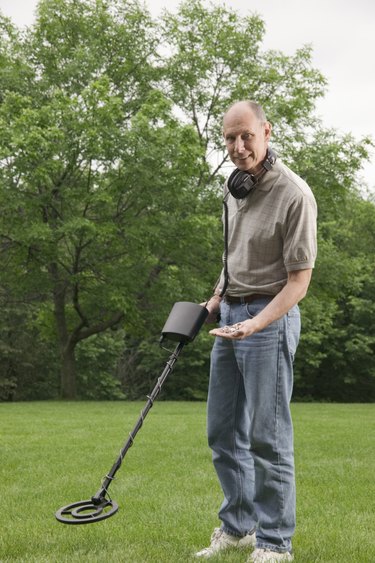
There are several constants about cast iron pipes that make them relatively easy to find. Usually, at least one end of them ends with a valve, drain or fitting. The pipe should also traverse a straight line. And cast iron conducts electricity much more efficiently than dirt, rock or concrete, so large, iron tubes are readily apparent to operators of metal detectors. With a metal detector, you should be able to locate cast iron pipes that are buried up to eight feet underground.
Step 1
Buy or rent a metal detector and familiarize yourself with the documentation that accompanies all new metal detectors. Read the documentation on the manufacturer's website if you buy a used metal detector. Buy or rent a metal detector that allows you to evaluate whether buried objects are ferrous or non-ferrous.
Video of the Day
Step 2
Determine, if possible, one end and the course of the underground cast iron pipe you seek. Begin your investigation there.
Step 3
Activate your metal detector and switch on the setting that allows the detector to ignore non-ferrous metal objects.
Step 4
Hold the disk-shaped detector coil just above the surface of the ground and slowly sweep the metal detector back and forth, like a broom, while you hunt for the underground, cast iron pipe. Search the area where you think the pipe is most likely to be buried first.
Step 5
Mark the straight line that contains buried iron or steel with surveyor's stakes.
Step 6
Confirm the location of the cast iron pipe by digging a trench under the line described by the stakes.
Video of the Day