Why Did Kings Start Wearing Crowns?

Circular headgear has been used in various cultures since at least 3000 B.C. to confer special status on the wearer and to set him or her apart as an extraordinary (often divine) being with a right to supreme governance and/or as having exceptional skills and achievements. Crowns, depending on their design and the materials of their composition, would draw attention to the wearer, and could enhance physical attributes, for instance, making the wearer appear taller.

  1. Early Mesopotamian and Hebrew Crowns

    • Mesopotamian crown

      In early Mesopotamian and Hebrew cultures, crowns, or diadems, could be made of cloth or metal and set with jewels or precious stones. In the Hebrew Bible, crowns worthy of kings are described as being made of gold (Ps. 21:3), and even small-time kings are mentioned as having crowns containing gold and jewels (2 Sam. 12:29). Although the materials used for crowns were commonly precious metals and jewels, the shape of the crown could vary; there are no indications that all crowns were similar in design.

    Egyptian Crowns

    • Egyptian "Double Crown"

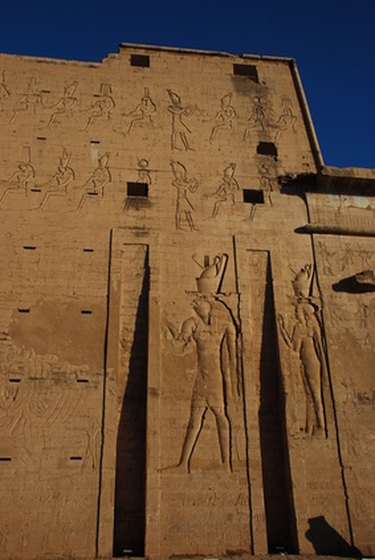
      Throughout Egypt's long dynastic history, kings and queens wore various crowns to represent the different offices and aspects of royal authority. From the Early Dynastic period and afterward, royalty used both crowns and scepters (the scepter being the most ancient sign of authority).

      Although no ancient Egyptian crowns have survived for material analysis, there are numerous pictures and sculptures that depict them. Egyptian crowns are most often represented as being very tall, with symbolic materials (such as feathers) that function to convey messages. An example of this is the "Double Crown," one crown composed of the two separate crowns worn by leaders of Upper and Lower Egypt, and so symbolizing the unified reach of the king's authority.

    Assyrian and Persian Crowns

    • Assyrian crown

      Assyrian monarchs wore crowns similar in style to that of the Egyptian monarchs. The high, conical style was similar to the headgear of priests, and was essentially an elevated, dyed and usually jeweled turban.

      In Persia, crowns were an important and highly individualized element contributing to the glory of a king. Each ruler wore his own distinctive crown that combined attributes of Persian deities, including eagles' wings and rams' heads; streamers were sometimes added.

    Greek and Roman

    • Greek and Roman "corona"

      Beginning in 776 B.C., the Greeks crowned the victors at the Olympic games with laurel wreaths. The town in which the games were hosted provided head garlands made from the branches of local trees (incidentally it is speculated that the practice of hanging wreaths comes from the practice of victors hanging their 'crowns' up on the wall or elsewhere). It appears that crowns of leaves or flowers were also put on the heads of festival revelers; the Hebrew Bible mentions the practice in the book of Isaiah and in the apocryphal book of Wisdom.

      In Rome, the purple toga and diadem signified kingship. Cicero writes in his third and thirteenth Phillipics about an incident in 44 B.C. when Marc Antony offered a diadem to Julius Caesar in the forum during the winter festival of Lupercalia. Caesar repeatedly refused the diadem, an act that made it clear that he did not intend to assume monarchical power over the Roman Republic. In Latin, the word for "crown" is "corona."

    The Crown in the Medieval (and Modern) West

    • King Alfred, in stained glass and on a coin

      In the Middle Ages, crowns were of two sorts. A crown was an object of state and a headpiece to be worn by kings and queens signifying their power on feast-days. There was also the diadem, the type of crown worn by Roman emperors and kings of pagan tribes. As state power mingled with the authority of the Church, crowns represented secular power mediated by or in partnership with ecclesiastical authority. Medieval art depicted Jesus and Mary with crowns, reminding secular leaders that true authority belonged to God. Sometimes crowns contained holy relics (such as the reliquary crown of St. Louis, which enclosed a splinter of the true cross). As in times past, the crown indicated that its wearer was divinely sanctioned to rule.

      Because the crown itself, unlike people, survived through many generations, it came to independently symbolize the office of kingship and identify a particular lineage.
      The British monarchy still today retains its "Crown Jewels," a set of regalia passed down through the generations since 1303. They are kept in the "Jewel House" in the Tower of London, on display to visitors and guarded by royal soldiers.

Related Searches:

References

Resources

Comments

You May Also Like

  • What Year Did Riverdance Start in the USA?

    Riverdance appeared as a seven-minute performance at the 1994 Eurovision Song Contest in Dublin, Ireland, and has since enjoyed unprecedented international success...

  • Why Do They Wear Wigs in Court?

    Members of England's House of Lords as well as English judges don white or gray horsehair wigs for sessions and trials. While...

  • Traditional Costumes of the Assyrian Villages

    The ancient Assyrian empire incorporated the lands now occupied by four countries: Turkey, Iraq, Iran and Syria. Assyrians are a Semitic people...

  • What Are the Duties of a Chief Priest?

    What Are the Duties of a Chief Priest?. The chief priest, also at times known as the high priest, had a significant...

  • Why Did Colonial Men Wear Wigs?

    Wigs were a fashionable item in colonial America in the 18th century. The full-bottomed periwig, which had a cascade of curls, was...

  • Ancient Greek School Projects

    Ancient Greek School Projects. Encourage students' interest in Ancient Greece with creative and historically accurate school projects. Make sure all projects are...

  • How to Make Egyptian Crowns

    These Egyptian crowns are easy to assemble and will top off an Egyptian Pharaoh costume for Halloween or school and church plays....

  • What Did a King Do in the Medieval Times?

    The medieval period lasted from around 500 A.D. to 1400 A.D. in England and Europe. Medieval kings were the absolute heads of...

  • Cute Hairdos That You Can Wear With a Crown

    Cute Hairdos That You Can Wear With a Crown. Crowns or tiaras are a common accessory to hairstyles when it comes to...

  • Types of Kings' Crowns

    Types of Kings' Crowns. A crown is a symbolic headpiece used to denote authority. A crown may be worn in the coronation...

  • How to Make a King Arthur's Crown

    Origami is the ancient Japanese art of paper folding. Origami gives both children and adults a glimpse into Japanese culture while learning...

  • How to Make a King's Crown

    Making king's crowns is a project that engages a child's imagination. Use the crown to let everyone know who the special birthday...

  • How to Make a Roman Emperor Costume

    Create a Roman emperor costume and be the leader of the toga party. This is also a good costume for a history...

  • How to Type a Crown Symbol

    If you feel like Myspace or Facebook royalty, you might want to add a crown symbol to your display name or to...

  • Why Do Muslim Men Wear Turbans?

    A turban is a headdress worn in variety of religions, including Islam and Sikhism. It is made out of a long, slender...

  • Ancient Rock Tools

    Ancient Rock Tools. One of the most ancient tool-making crafts is flint knapping. Beginning around 4 million years ago, people learned to...

  • What People Wore in the Medieval Times

    With wars, societal changes, and economic development all happening on a grand scale in the Middle Ages, what people most commonly talked...

  • How to Make a Kid's King Crown

    If you have a son that enjoys learning about medieval history, knights, kings and castles, he might like to have his very...

  • How Did Gospel Music Start?

    Gospel music can trace its roots to African-American spirituals, and spirituals can trace their roots back to the "corn ditties" sung by...

  • What Did Ancient Egypt Pharaohs Wear?

    The clothing of Egyptian pharaohs differed substantially from that of the common Egyptian man. The only similarities in clothing were the robe...

Related Ads

Featured