The History of Oriental Art

The History of Oriental Art thumbnail
The History of Oriental Art

Oriental art is one of the major branches of art classification, along with European art, art of the Americas, African art and Middle Eastern art. The development or distinct artistic styles in Japan, China and other eastern Asian nations has influenced art around the world for thousands of years, and reveals a great deal about the cultures that produced it.

  1. Japan

    • Some of the first significant art to emerge from Japan dates to the seventh century. Japanese artists came to know the styles of Chinese and Korean art as the cultures shared their Buddhist beliefs, and Japanese art from this era is a fusion of Korean and Chinese. Bronze sculpture dominates Japanese art from the Asuka and Nara periods (roughly the years 550 to 780). Buddhism continued to dominate Japanese artistic subject matter until 1180, when widespread war within Japan changed the national mood from one of religious introspection to one of conflict and survival, and Samurai culture was born. In creating war-themed art, Japanese artists adopted a new realism in their work. Calligraphy also emerged as an art form during this time. By the Muromachi era (1338 to 1573), Japanese art looked back to its roots in spirituality. Japanese painting and printmaking flourished during this period, with subjects ranging from the natural world to ancient mythology.

    China

    • Long before Japan was first settles, early cultures produced primitive art in China. Since then, Chinese art has been extremely diverse, colored by the shifting dynasties and the influence of foreign cultures. By the second century B.C., China already had a distinct artistic style in poetry, sculpture and music. One of the most well-known pieces of Chinese art today is the Terracotta Army. Dating from 210 B.C., it consists of 7,000 life-sized figures in the tomb of the first Qin emperor. The Terracotta Army points to the Chinese preoccupation with military subjects, the human figure and associating art with burial rituals.
      Buddhism influenced Chinese art in the first century. Through the cycles of dynastic rule, which lasted until the early twentieth century, Chinese culture remained in a state of frequent change, and a diverse national body of art was produced as a result.

    Korea

    • Korean art, like Chinese art, dates from the early days of human civilization. Due to its geographical location, Korea has often served as a point of transit between China and Japan, and its art shows the influences of both cultures. From the first century B.C. to the seventh century A.D., some of the most notable Korean art was produced in the Baekje kingdom. Art from this region of southwestern Korea consists primarily of architecture and sculpture. Harmonious proportions, naturalism of form and the presence of Buddhist subject matter suggest the influence of nearby China as well as Japanese traditions. Beginning in the first century B.C., Korean painting became an established art form. Beginning with the decorated walls of tombs, Korean painting has been sharply divided between delicate, realistic compositions intended to be viewed as works of fine art and colorful, stylized folk art images that commemorate celebrations.

    Tibet

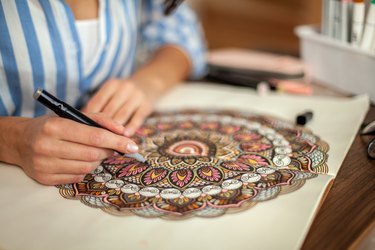
    • Tibetan art is defined by its inclusion of Buddhist subject matter and principles, even more so than the art of other Oriental cultures. Elements of Buddhist influence can be found in Tibetan art dating from as far back ad 400 B.C. Geometric patterns, meant to be contemplated while the viewer meditates, are a common image in Tibetan art. Various Buddhist deities are also frequently represented both in sculpture and painting. Oftentimes these images are also intended to aid in meditation. Tibetan art is full of symbolic images, such as the Dharmacakra, which is a wheel with eight spokes, each representing one of the eight paths to enlightenment. Among Tibetan art's most well-known forms is the sand mandala. These geometric images, painstakingly constructed by Buddhist monks as a means of concentrating their energies, are ritualistically destroyed as a means of representing the impermanence of life.

    Vietnam

    • Vietnamese art has been characterized by the various imperialistic presences in Vietnam, from the Chinese to the French. From the tenth century to the fifteenth century, Vietnam was independent and produced art that is distinct from anything brought by outside cultures. Vietnamese art from this period responds to a blending of religious traditions with elements of Taoist, Buddhist and Confucian principles. Ceramics have figured prominently in Vietnamese art both during periods of Chinese rule and Vietnamese independence. Vietnamese ceramic artists have often employed a limited color palette as a way of emphasizing form. Interest in ceramic and porcelain art dominated Vietnamese art through the Nguyen dynasty in the nineteenth century.

Related Searches:

References

  • Photo Credit Hiart, wikimedia.org

Comments

You May Also Like

  • The History of Oriental Floral Design

    A style with great emphasis on minimalism, Oriental floral design is one of the two major branches of floral design today, with...

  • Types of Oriental Art

    Types of Oriental Art. Oriental art encompasses a wide range of styles and historical periods. The term "oriental" can refer to many...

  • Facts on Oriental Art

    When Oriental or Asian art first hit the shores of Europe and America it brought a fresh perspective to art movements that...

  • Oriental Painting Techniques

    Oriental painting techniques have a lengthy history rooted in Eastern culture. The objective is to focus on simplicity and capturing the essence...

  • How Can I Learn Oriental Leather Brush Art?

    Also called name painting, leather brush art originally came from China and Korea. Calligraphers use this method to write a person's name...

  • Origins of Oriental Calligraphy

    An ancient art, Oriental calligraphy is still a popular hobby in China and around the world. Calligraphy is called "shu fa" in...

  • The History of Asian Art

    The various Asian cultures of China, Japan and Korea all have made significant contributions to the art world. Asian art not only...

  • Traditional Oriental Paintings of Birds

    Asian art is filled with deep spirituality and symbolism. China has a vast history in implements and artistry. Symbolism in oriental art,...

  • Information on Asian Art

    Modern art movements as diverse as Impressionism, Post-Impressionism and Art Nouveau all owe a culture debt to Asian art. Like its European...

  • The History of Russian Oriental Rugs

    Russians have not traditionally been involved in the making of Oriental carpets, but Russians have been the largest supporters of the art...

  • History of Tibetan Mandalas

    The mandala is an art form tied to the spiritual beliefs of Buddhism. Tibetans began to create mandalas early in their introduction...

  • Origins of Falconry

    The origins of falconry are debated, but the "Epic of Gilgamesh" appears to prove that the sport began in the Middle East...

  • Instructions for Oriental Leather Brush Art

    The craft of Oriental leather brush art originated in Korea and uses leather-tipped brushes and water colors to create calligraphy styles in...

  • The History of Oriental Dance

    The art of Oriental dance, or belly dance, has its roots in the fertility cults of ancient Mesopotamia. (The term "orient" is...

  • The History of Oriental Lilies

    Images of the lily flower have withstood history. Dating back to 1580 B.C., Assyrian etchings and Egyptian tombs depict the lily once...

  • Chinese Influence on Early Japanese Culture

    Chinese culture has fundamentally influenced Japan by shaping its art, religion and politics. Japan even lacked written language until the Chinese introduced...

Related Ads

Featured