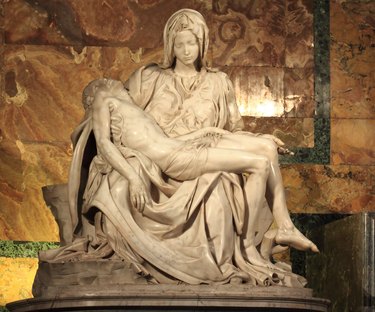
In 1498 Michelangelo Buonarroti was already an accomplished sculptor. Just 24 years old and relatively unknown, he embarked on an enormous project. The French cardinal Jean de Billeheres represented Rome at the time, and he commissioned Michelangelo to sculpt a statue that would mark the cardinal's funeral monument after his death. Today, this statue, "The Pieta," is displayed in St. Peter's Basilica in Vatican City. One of Michelangelo's most famous works, "The Pieta" shows the body of Jesus draped across his mother Mary's lap. Its beautiful mixture of design elements makes it one of the most valued statues in modern history.
Texture
Video of the Day
Although "The Pieta" is made exclusively of Carrara marble, which is very smooth, it appears to have a great deal of texture. From Jesus' lifelike wavy hair to the folds in Mary's dress and veil, the piece gives the idea of having varied texture. Even the skin of Mary and Jesus appear to have texture in all the right places. For example, Jesus' hand that hangs down below Mary's knee has fine lines on its knuckles and fingers.
Video of the Day
Shape
The overall shape of "The Pieta" is triangular, which gives it a harmonious symmetry and draws the eye to Mary's solemn and beautiful face. Mary's head is at the pinnacle of the triangle, and Jesus' feet form one of the other points of the triangle. The third point of the triangle is a pedestal on which Mary props one of her feet. Within the triangular shapes, Michelangelo uses other shapes for unity and interest. Mary's face is an oval, and the position of Jesus' body makes a less severe, obtuse triangle, inverted inside the main triangle.
Line
The mood of "The Pieta" is somber, but the lines utilized in the composition give it energy and life. The folds of Mary's clothing create lines in many directions. Most of these lines are diagonal in one direction or another. Jesus' body has many fewer distinct lines, which emphasizes his lifelessness. A diagonal sash crosses Mary's chest toward Jesus' chest. This line subtly gives the viewer the message that they are absolutely connected.
Direction
The direction of the lines in "The Pieta" is very intriguing. Traditionally, horizontal lines suggest stability, tranquility and calmness, which would seem to be ideal qualities for the subject. Vertical lines suggest alertness, balance and formality, which would also be appropriate for the subject matter. "The Pieta" includes very few vertical and horizontal lines. The only horizontal lines belong to the rock on which the two figures rest. Instead, Michelangelo chooses to construct his piece with diagonal lines, which traditionally represent movement and action, although the two figures in the scene are as still as can be. These diagonal lines give "The Pieta" an intriguing and lifelike aura.
Value
"The Pieta" is constructed from a single piece of Carrara marble, the same marble used for Michelangelo's "David," the Pantheon in Rome, the Marble Arch in London and the Duomo di Siena. Michelangelo preferred Carrara marble because he felt it had a luminous quality much like human skin. To achieve different values in this sculpture, Michelangelo constructed curves and recesses that would create shadows to make different values. Using only white stone, he had to count on the light to create these values. Dark shadows appear in the folds of Mary's clothing, around her neck, and beneath Jesus' body. In contrast, the piece is most luminous on Mary's face and on the body of Jesus.