Giant Water Lily Flower Facts

Giant Water Lily Flower Facts thumbnail
Giant water lilies were seen by European explorers as early as 1801

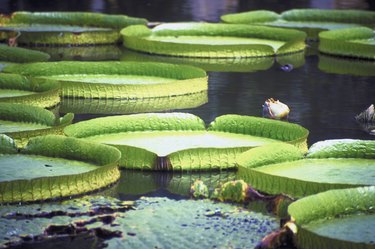
The giant water lily, or Victoria amazonica, is known for its floating, 4- to 6-foot diameter leaves, which are surrounded by a 2- to 4-inch ridge. Native to the Amazon region of South America, the aptly named giant water lily has been found along the banks of the Amazon River and once was grown in England's Kew Gardens during Queen Victoria's reign. Does this Spark an idea?

  1. Size and Scope

    • Also known as the Amazon water lily, royal water lily or Amazon water-platter, the giant water lily is an aquatic, oval-shaped perennial that catches the eye with its floating leaves. Even more striking is the lily's outer edge, which rises 2 to 4 inches around the perimeter of the leaf. The giant water lily's leaves are yellow-green in color with a copper-colored, prickly underside.

    Blooming Characteristics

    • The giant water lily's pineapple-scented, night-blooming flowers emerge at dusk and close by noon. The 9- to 12-inch-size flowers bloom for three days, starting with a creamy white shade on day one, a pinkish hue on day two and a purplish-red color on day three. Strongly fragrant and double-sized, the giant water lily's blooms occur annually from July through August.

    Hardiness and Cultivation

    • Considered a high-maintenance specimen, giant water lilies are often grown in containers for specialized water gardens, pools or ponds. Giant water lilies can be cultivated in U.S. Department of Agriculture hardiness zones 10 and 11, as long as water temperatures do not dip to less than 75 degrees Fahrenheit. A tropical-hardy plant, the giant water lily requires plenty of full sun and water depths of 1 to 3 feet. While a giant lily is generally immune to most insect and disease problems, the water environment should be free of any splashing, heavy winds or strong currents, according to the Missouri Botanical Gardens.

    Unusual Facts

    • The petioles and midribs of a giant water lily are sharp enough to prevent coagulation of the blood, which can be dangerous in areas of the Amazon River where piranas swim. The giant leaf is more buoyant than it looks and will even support the weight of a man. The plant's scientific name, Victoria, was added in 1837 as a tribute to Queen Victoria by English botanist John Lindley, who introduced the specimen in the Kew Gardens. In Missouri's Botanical Gardens, some of the giant water lily specimens on site can be traced to the Kew Gardens.

Related Searches:

References

Resources

  • Photo Credit Photos.com/AbleStock.com/Getty Images

Comments

You May Also Like

  • Facts on Water Lilies

    The water lily, whose scientific name is Nymphaeaceae, is one of the world's most beautiful and recognizable plants. The water lily is...

  • Information on Water Lily Flowers

    Some states, such as Washington, consider water lilies as invasive species, since these aquatic plants have the ability to clog waterways and...

  • Water Lily Plant Information

    Water lilies are aquatic plants that float on the surface of calm freshwater ponds and lakes. They make an excellent addition to...

  • Facts On the Amazon Lily

    The Amazon lily (Eucharis grandiflora) is a member of the Amaryllidaceae family, which is a family of perennial plants. It originates from...

  • Life Cycles of a Water Lily Plant

    The water lily is a true aquatic plant that keeps its blooms above the water. Water lilies can be either day or...

  • Information About Water Lilies by Monet

    Monet's style of painting as well as his most famous work, Waterlilies, is explored. For full understanding, it's important to take a...

  • Water Lily Problems

    Water lilies are more than a parking lot for frogs. The plants decorate the surface of ponds and other water features with...

  • Information on Lily Flowers

    Lilies are considered the star of summer, because they bloom when other flowers have faded away. Lily flowers have a hardy reputation...

  • Orange Flower Water Substitute

    The Internet and cable cooking shows have allowed home cooking to expand far beyond the recipes you would have been able to...

  • Fun Facts for Wetland White Water Lilies

    Water lilies grow throughout much of the world, with several species native to the United States and many European countries. These floating...

  • Royal Lily Pad Information

    "Royal lily pad" is one of the common names for Victoria amazonica, also known as the giant waterlily or the Amazon waterlily.The...

  • How to Use Downriggers

    So, you want to fish for the giant lake trout you're always hearing about, but you have never used a downrigger, a...

  • Information on Lily Pads

    Lily pads (Nymphaea) are the floating leaves of water lilies. They can grow anywhere standing water exists. According to the Washington State...

  • How Much Water Do Giant Calla Lilies Need?

    Calla lilies (Zantedeschia aethiopica) are one of the few plants that thrive in a constantly damp or boggy location in the garden....

  • About the Process of Filtering Water at a Water Purification Plant

    Processing at water purification plants makes water supplies safe to drink. The level of treatment required depends on the original water quality...

  • Amazon Lily Fast Facts

    The Amazon lily is a beautiful plant that grows both indoors and in greenhouses. The scientific name for the Amazon lily is...

  • How to Make a Birdbath Out of a Giant Leaf

    Bird baths are useful and decorative ways to attract wildlife to your yard. Though bird baths come in different shapes and sizes,...

  • The Best Place to Grow Night Blooming Jasmine

    Night-blooming jasmine is also known as the lady of the night. It is a medium-sized bush that produces white-colored, small, tubular flowers....

Related Ads

Featured