How to Evenly Space Sleeve Decreases in Knitting Top Down Sweaters

How to Evenly Space Sleeve Decreases in Knitting Top Down Sweaters thumbnail
Use simple math and measurements to determine decrease placement on top down sweater sleeves.

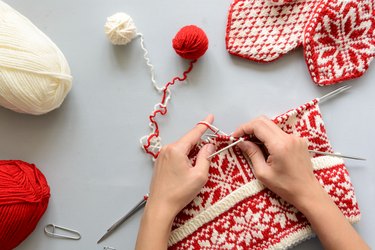
Knitting sweaters from the top down is a way to produce a seamless, or near seamless garment. When you knit from the top down, you will complete the yoke of the sweater first, before placing the sleeve stitches on waste yarn and continuing to knit the rest of the body of the sweater. The sleeves stitches are picked up and knit after the main body of the sweater is completed. In some cases, pattern designers simply state to decrease for the sleeve evenly, as they don't specify a sleeve length. In order to determine the spacing of the decreases, some knitting math is required.

Things You'll Need

  • Measuring tape
  • Paper
  • Pen
  • Calculator
Show More

Instructions

    • 1

      Knit a gauge swatch. To evenly decrease stitches when knitting sleeves on top down sweaters, you will need to know both your row width and height gauges. Measure how many stitches per inch you get across a horizontal row, and how many rows per inch vertically.

    • 2

      Measure the length of the sleeve. Take a measurement from the armpit to the wrist, or where you want the sleeve to stop. Measure the girth of the upper arm, just underneath the armpit and measure the wrist girth as well.

    • 3

      Multiply the number of rows per inch (row height gauge) by the length of the sleeve. This will be the total number of rows you will knit to achieve the desired sleeve length. For example, if your sleeve measurement is 16 inches and your row height gauge is four rows per inch, you will need to knit 64 rows to complete the sweater.

    • 4

      Estimate the number of inches of the sleeve opening width. Count the number of stitches on waste yarn for each sleeve, and divide by your row gauge. For instance, if you have 30 stitches for a sleeve, and your gauge is three stitches per inch, your sleeve opening is 10 inches.

    • 5

      Subtract your wrist measurement from the sleeve opening measurement to determine how many inches you will need to decrease. If your sleeve opening is 10 inches and your wrist measurement is 5 inches, you will need to decrease by 5 inches. Multiply 5 inches by your stitch gauge (three stitches per inch) to determine the number of stitches you will need to decrease along the sleeve, which in this case is 15.

    • 6

      Divide the number of rows needed to complete the sleeve by the number of stitches you will decrease. Generally, knitters decrease at the beginning and end of a row, so divide the number of stitches to be decreased by two. Since you can't decrease by half stitches, round up to the nearest even number, in this case 16. In this example, you will need to decrease on eight rows. Since your sleeve will be 64 rows long, and you need to decrease eight rows, you will decrease every eighth row, to space it evenly throughout the sleeve.

Related Searches:

References

  • Photo Credit Female hand in a warm blue sweater image by YURY MARYUNIN from Fotolia.com

Comments

You May Also Like

Related Ads

Featured