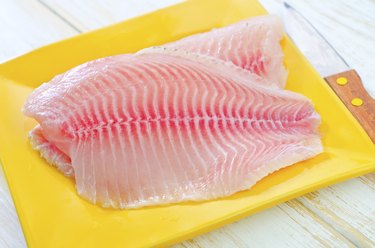
Mild tilapia easily takes on the flavors of seasonings or other ingredients in a dish, from light citrus flavors to a spicy Cajun kick. Tilapia can be cooked whole, but it is more commonly filleted to remove the meat from the bones. The delicate, flaky meat performs best in baked, broiled and skillet preparations -- it flakes apart and sticks too easily to a grill. Serve whole fillets with side dishes, or flake the cooked fillets for use in dishes such as fish tacos.
Dress to Your Fancy
Video of the Day
Fish scales only require removal when leaving the skin on fillets, but some people prefer to scale the fish in any case. Scrape a fillet knife across the fish from tail to head to force off the scales. Scrape all over the tilapia, including the belly and around all fins.
Video of the Day
Removal of the organs and intestines -- gutting the fish -- is also optional when cutting fillets, but can be done as a matter of preference. Hold the tilapia belly up and pierce through the skin just above the tail. Slice up the belly about one-third of the way up the fish, but keep the cuts shallow to avoid piercing the organs. Insert your fingers into the belly, then up into the chest area, and pull all the organs and intestines out of the body. Rinse the body cavity with cool water to remove blood or lingering parts.
Headed in the Right Direction
Fillets are cut from the sides of the fish, between the head and tail, which can be done without cutting off the head. The heads are a common addition to soups or broths, so it might be removed as part of the fillet process. Regardless of whether the head is left on, filleting tilapia begins with cuts near the head. Locate the gills, technically called the operculum, and the pectoral fins, the foremost fins just behind the head and near the belly on either side of the fish. Position the fillet knife behind the gill and pectoral fin -- the placement of these parts guides the knife angle. Slice straight down about halfway through the fish until you reach the bones.
To leave the head intact, stop at this point. To remove the head, repeat this on the opposite side, then press hard to cut through the spine. Some chefs smack the back of the knife with a mallet to help break through the bones and separate the head from the body.
The Slice Is Right
A very sharp fillet knife is especially important when actually cutting the fillet away from the tilapia body. Turn the knife parallel to the cutting board -- perpendicular to the cut behind the head -- with the blade facing the tail. The blade rests on top of the bone that was the stopping point when cutting behind the gills, and immediately to the inside of the dorsal fin that runs along the top of tilapia.
The meat is attached to the rib bones at the front of the fish, so insert the knife tip only about 1/2 inch deep. Glide the knife along the dorsal fin, down to the tail. You'll notice a freedom of movement on the blade tip when you get past the ribs, at which point you can pierce all the way through the belly -- this only applies if you did not gut the fish -- and continue down to the tail. Return to the front of the fish and peel back the flesh with your fingertips. Slowly make several quick slits as needed to trim the flesh away from the ribs, freeing the fillet. Repeat this process to cut the fillet from the opposite side of the fish.
The Skinny
Tilapia skin adds a layer of crispness to the tender fillets and also helps hold the flaky meat intact. Tilapia fillets found in bags in the freezer section are typically sold with the skin removed -- again, a matter of preference.
To remove the skin from fillets, hold the fillet flesh-side up by the tail end with the head end facing away from you. Some people like to stop cutting fillets just short of the tail so the tail can be used as a handle for removing the skin. Cut down into the flesh at a slight angle until the blade reaches the skin. Turn the knife so the blade is parallel with the tabletop and the blade edge facing the head end. The tip of the knife should stick out on the side of the fish opposite the handle. Glide the knife to the head end of the tilapia while keeping the knife between the flesh and skin. For large fish, you may wish to cut large fillets into smaller ones at this point.
Where to De-Pin
Tilapia usually have a series of sharp pin bones extending from the center of each fillet out about two-thirds of the way to the edges. These are not nearly as large or numerous as pin bones in some fish species, but are an unwanted addition to a tilapia meal. The pin bones protrude out into the meat from a subtle line that runs down the center of the fillets. Feel for the bones with your fingers. If there are only a few, pull them out with a pair of clean tweezers or needle-nosed pliers.
If there are several pin bones as is often the case with large tilapia, it may be more practical to pull them out at once. Cut downward at an angle on either side of the subtle line; the point made by the diagonal cuts meet centered under the line. Lift at one end and pull this V-shaped strip -- and the attached pin bones -- out of the fillet in one motion.