This Season
 

How to Use a Sewing Machine

How to Use a Sewing Machinethumbnail
Use a Sewing Machine

Once you know how to do a basic straight stitch on your sewing machine, you can move on to more complex machine stitching techniques. If you're used to sewing by hand you will notice how much time you'll save with a sewing machine.

Related Searches:
    Difficulty:
    Moderate

    Instructions

    Things You'll Need

    • Fabrics
    • Scrap Fabrics
    • Sewing Machine Needles
    • Spool Of Threads
    • Pair Scissors
      • 1

        Read the owner's manual that came with your machine and familiarize yourself with its various parts and capabilities.

      • 2

        Raise needle to its highest position by turning handwheel at the right of the machine toward you. Make sure that the needle you are using is the correct size for the fabric you are sewing.

      • 3

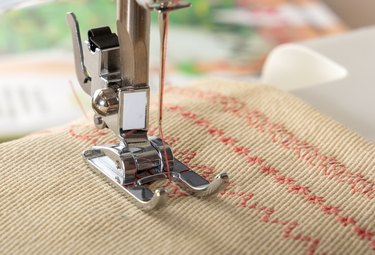
        Raise presser foot.

      • 4

        Thread sewing machine and pull top and bottom threads to the right and back of the machine.

      • 5

        Place layers of fabric to be sewn to the left and underneath the raised presser foot.

      • 6

        Position fabric so that the distance between the fabric edges and the needle is equal to the required seam allowance.

      • 7

        Lower presser foot onto positioned fabric and move machine handwheel toward you until needle pierces the fabric.

      • 8

        Begin stitching by pressing on machine foot pedal and gently guiding fabric as it is pulled to the back of the machine. Try not to exert any pressure on fabric other than what is needed to evenly guide fabric in as accurate a stitching line as possible.

      • 9

        End stitching by raising needle to its highest position.

      • 10

        Raise presser foot and pull stitched fabric out and to the left.

      • 11

        Cut bottom and top threads in order to release fabric.

    Tips & Warnings

    • Keep a variety of needle sizes among your sewing supplies. This will allow you to quickly adjust the size if necessary.

    • Test stitching on sample fabric in order to determine whether stitches are too loose or too tight and to observe stitch length. Adjust stitch length and tension dials as needed.

    • Spend some time testing different combinations of stitch length and tension levels on a variety of fabrics. This will help you get a feel for what stitch settings will and won't work for some fabrics.

    • Take care not to let your right hand get under the needle clamp while guiding fabric. The needle clamp goes rapidly up and down along with the needle and can hit your hand if you're not careful.

    Related Searches

    Read Next:

    Comments

    • tinacjones Dec 06, 2010
      i am making a twin quilt 10 1/4 in blocks the quilt is 63x87 who many blocks do i need
    • cherryveba Sep 02, 2009
      Do NOT pull the fabric out to the left when finished, as this will bend the needle...trust me I did this and ended up in a&e with needle broken thru my finger! Never use the thread cutter either...ALWAYS pull fabric to the back of the machine and snip the cotton with scissors. You need different needles sizes for different fabric, a higher number for thicker fabrics, and ball point needles for jersey or stretchy fabrics. Andronicus--at a guess I would be thinking the needle is wrong the wrong size for the fabric? (altho this was posted months after your comment so you prob already figured this lol) Get to know the basic needle sizes for fabrics, and most patterns will give you the seam allowance :o)
    • sqwertbird Dec 20, 2008
      how do you know proper needle size and seam allowance
    • sqwertbird Dec 20, 2008
      how do you know proper needle size and seam allowance
    • djvdyne Nov 22, 2008
      How do I thread the bobbin

    You May Also Like

    Follow eHow

    Related Ads