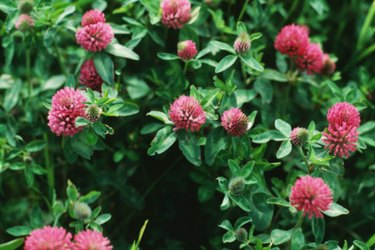
Red clover is a useful forage crop and often harvested for hay. It makes an excellent cover or green manure crop and improves soils greatly. Red clover is a perennial legume and useful in rotation with non-legume crops as a soil nitrogen contributor. It also helps reduce soil erosion, increases tilth and reduces weeds. Apply red clover seed at 10 to 12 lbs. per acre.
Uses for Red Clover
Video of the Day
Often intercropped with spent plants such as corn stalks, red clover provides increased nitrogen when tilled into the soil and improves the soil texture for the next crop. It is a source of food for some animals and may be harvested for hay for domestic farm stock. As a cover crop, the red clover is tilled in to provide important nitrogen and other nutrient yields to soil. It can contribute up to 60 lbs. per acre of pure nitrogen when seeded as the sole crop.
Video of the Day
Varieties of Red Clover
Red clover comes in two main types: an early flowering and a late flowering version. Early flowering clover produces three crops for hay and is also called medium red clover. Mammoth red clover is the late flowering type and only produces one crop with a little residual growth after harvest. Rates for seedling will diminish slightly when using the mammoth red clover, which produces a larger plant. The medium is generally considered a better choice for hay and the mammoth is a good plant for cover crops and provides more nitrogen per acre.
Seeding Rates
When sowing red clover by itself, the seeding rate is 10 to 12 lbs. per acre. When you mix it with grass, the rate drops to 8 lbs. per acre. Grass seed in varying combinations will make up the remaining weight. For example, for every 8 lbs. of red clover seed you need 6 lbs. of orchard grass. This is a useful combination for hay or grazing pastures. As an intercrop plant, red clover is often planted among wheat, barley, rye or oats. The seeding rate is by bushel and is 3/4 for most grains and 1 1/2 for oats.
Growing Red Clover
Red clover is a versatile and useful crop and sown in tilled or compacted soils. Spring seeding is best for crop production. It can be cut every 35 to 42 days during the spring and summer if there are rains. The plants need 45 days to store carbohydrates for over wintering, which means you have to stop cutting well before fall. Fall seeding can be done for cover crops when inter-sown with an existing crop. Otherwise, you can seed it in late winter to early spring for a crop used in the summer as forage and tilled into soils in fall for nitrogen enrichment.