Things You'll Need
Forceps or smooth pliers
Gloves
Jar of alcohol
More closely related to spiders than to insects, ticks are small, biting arachnids that adhere to the skin of people and pets alike in order to feed. Correct tick removal is a handy skill when you or someone you know spend time enjoying the great outdoors. The most dangerous part of being bitten by a tick is the chance of contracting Lyme disease, although it is important to remember that not all ticks are infected. One of the most effective ways of removing a tick is with a pair of tweezers, but these may not always be available. It's possible to safely remove ticks without tweezers.
Glove Up for Tick Removal
Put gloves on to remove the tick. Removing ticks should not be attempted with bare hands. A tick can easily latch on to the person trying to remove it and release toxins into the bare skin. Latex or surgical gloves will work well, protecting the hands while not interfering with movement.
Video of the Day
Video of the Day
Tools for Removing Ticks
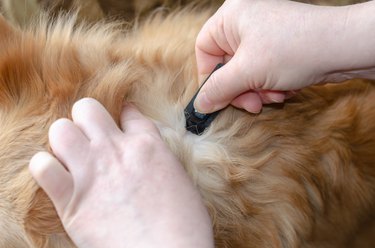
Find a tool to replace the tweezers. Use needle-nosed pliers or forceps. Leatherman pliers also work in a pinch for tick removal. The head of the tool should be small enough to grip the tick without crushing it, and the inside should be smooth to keep from tearing the body and releasing toxins.
Grasp the Tick Gently
Grab the tick as close to the skin as possible, gently, not squeezing hard enough to crush the arachnid. When ticks bite, they latch onto the victim with mouthparts. Different types of ticks have different types of bites, and holding the animal as close as possible to the skin will help remove the tick without leaving pieces behind.
Avoid Tick-borne Disease
Draw the tick out of the skin with a smooth, gentle motion, continuing to be careful not to squeeze the arachnid. As long as there is a connection between the tick and the skin, infection can be passed from the tick to the host. Squeezing the animal's body will release the contents of the tick directly into the wound during an incorrect tick removal. Be sure the movement is straight and along the same angle at which the tick's body is positioned to prevent breaking and tearing.
Kill the Tick
Place the tick in a jar of alcohol to kill it.
Clean and Disinfect
Wash the affected area thoroughly with soap and water and apply a disinfectant solution in case there is the presence of any type of bacteria. Don't apply the disinfectant prior to removing the tick as early application can result in the irritation of the animal, causing it to release and transfer bacteria. It may be necessary to also remove the mouthparts of the tick. Don't panic if these parts are left behind -- this does not increase the likelihood of infection.
Tip
According to the Center for Disease Control and Prevention (CDC), you should see your physician if you notice a fever or rash within several weeks of the tick removal. The doctor will need to know when and where you encountered the critter.
Warning
There are a number of folk remedies for the removal of ticks, and many of them do not work. Some, including using soap to get the tick to let go, burning the tick off, soaking it with nail polish remover or smearing petroleum jelly over it are completely ineffective. Further, these home remedies will actually escalate the likelihood of infection by prolonging the amount of time the tick is attached as well as increasing the trauma to the tick's body.
- Cornell College of Agriculture and Life Sciences: Don't Get Ticked NY – Tick FAQs
- Harvard Medical School: Matchless Strategy for Tick Removal; 6 Steps to Avoid Tick Bites
- University of Maryland Extension: How to Check Your Cattle for Ticks
- Center for Disease Control and Prevention: Tick Removal
- Binghampton University of New York: Tick/Lyme Disease Prevention