How to Draw a Microscope

How to Draw a Microscope thumbnail
Draw a Microscope

Microscopes have been an important part of science for years. By looking into a microscope we have learned more about the structure of our own bodies, cells and even bacteria. Being able to examine chemicals, blood and plant matter closely has provided us with breakthroughs in medicine and technology. Drawing a microscope can best be accomplished by breaking the tool down into its various parts and drawing each of these as geometric shapes.

Things You'll Need

  • Paper Pencil Black Ink Pen Kneaded Eraser
Show More

Instructions

    • 1

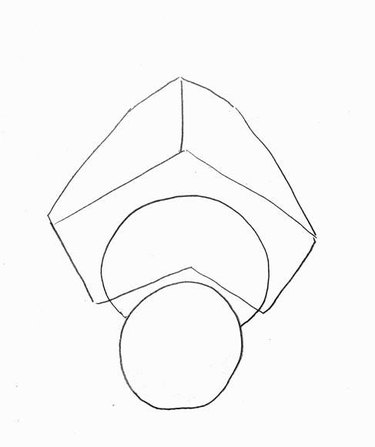
      Draw a long rectangle pointing diagonally to the left corner of the page. Add on top of this a smaller rectangle pointing in the same direction. Attach a curved line to the upper left-hand side of the larger rectangle for the "arm" of the microscope. Add two small circles one intersecting the curved line at the top of the curve and the other just below this.

    • 2

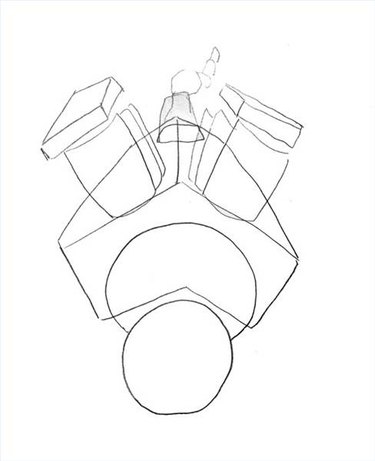
      Draw and parallelogram. A 4 sided shape made of pairs of parallel diagonal and straight lines for the display tray known as the "stage". Attach this shape to the bottom of the curved line. Draw a square shaped parallelogram attached to the bottom left corner of the first parallelogram. Add a curved "c" shape that intersects the square parallelogram to create the base of the microscope.

    • 3

      Draw an oval at the bottom of the large rectangle. Attach 3 small rectangles to the oval. Make the stage seem 3-dimensional by adding parallel lines to the bottom of the parallelogram. Connect these shapes at the corners with vertical lines.

    • 4

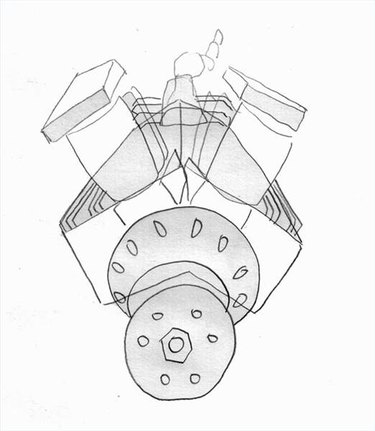
      Add parallel lines to the curved line attached to the rectangle. This will create the neck of the microscope. Add a parallel curved line around the bottom of the base on the left outer side and inner right side. Draw a cube directly under the stage by drawing one square with a parallelogram attached to the top and right side. Draw two small semi circles under the front tips of the base, located on the right hand side.

    • 5

      Draw a line running horizontally across the top of the smaller rectangle to create the scope. Add another line at the base of this shape. Add a small thin rectangle at the top of the main, large rectangle. Add two parallel lines to the cube under the display tray. These lines will act as the power supply for the microscope's light.

    • 6

      Ink the entire drawing. Let the ink dry. Erase all of the pencil lines. Add horizontal lines to the cube to make the material appear corrugated. Add a small circle inside the middle of the display tray to create the hole for the light to come up.

Tips & Warnings

  • Be sure to let the ink dry before erasing the pencil otherwise the picture will smudge.

Related Searches:

Resources

  • Photo Credit Illustrations by Andrew DeWitt

Comments

You May Also Like

  • How to Draw a Microscope

    To draw a microscope, begin by mapping out its structure in three dimensions, start adding in the characteristic details, and shade one...

  • How to Draw From Microscope Slides

    The earliest images we have of cells and microorganisms were drawn by scientists like Leeuwenhoek looking through a microscope and sketching what...

  • Common Uses for a Light Microscope

    Common Uses for a Light Microscope. Light microscopes use light to detect small objects and are the most commonly used microscope. They...

  • How to Calculate Drawing Magnification

    Drawings within the sciences and engineering serve as easy ways of representing the very small without needing a microscope. Biology classes often...

  • How to Determine Drawing Magnification

    Peering through a microscope enlarges what we see and reveals a hidden world that most people rarely notice. Magnification quantifies this enlargement...

  • Microscope Activities

    Budding scientists enjoy microscope activities to investigate what can't be seen with the naked eye. Although the use of a microscope is...

  • How to Make a Microscope E Lab

    The Microscope E Lab is a fun and effective way to introduce students of all ages to the microscope. In this lab...

  • How to Use a Light Microscope to View Cell Content

    Light microscopes can be used to accurately view cell content, such as nucleus, cell membrane and cytoplasm. The light in the light...

  • The History of Microscopes

    The first microscope was invented in 1590. Drawing from the innovations made so far, plus experience gained in their spectacle-making business, the...

  • How to Draw Scientific Equipment

    The origin of science goes back centuries and often began with a simple drawing of scientific equipment. The writings and drawings of...

  • How to Make a Microscope

    Looking through a microscope opens a whole new world to a child. You can make your own microscope with items you can...

  • How to Make a Simple Microscope

    A microscope is an instrument used for looking at objects that are too small to see with the naked eye. A microscope...

  • How To Use a Compound Microscope to Study Cells

    Microscopes are important tools used to view things we cannot see with the naked eye. Cells are the building blocks of living...

  • How to Draw a Skull

    Just in time to get ready for Halloween, here's an easy way to draw a skull in pen, marker, Conte crayon, charcoal...

  • How to Use a Light Microscope

    If you or your children like any of the sciences, then likely a microscope is involved. Many types of microscopes exist but...

  • How to Make a Microscope With Children

    Microscopes are a great way for children and adults to examine the small parts of the world. They can bring light to...

  • How to Use a Polarized Light Microscope

    Polarized light travels on one plane or, very simply, in one direction, according to Physics Classroom. Unpolarized light, on the other hand,...

  • How to Identify Microscope Parts

    A microscope is a piece of laboratory equipment used to view tiny organisms that cannot be seen with the naked eye. However,...

  • Parts of a Compound Microscope

    The compound microscope consists of optical and structural parts which together are used to magnify objects that are too small to be...

Related Ads

Featured