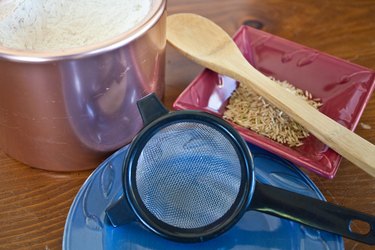
How to Use a Fine Mesh Sieve

A fine mesh sieve, like so many other overlooked kitchen utensils, is the thing you are looking for when you don't know exactly what you need. It can solve problems with sauces, soups and wine, and it's usually right underneath your nose--or at least tucked away in a drawer. No serious cook can possibly live without it. Once you know all of its amazing uses, you too will be running to your kitchen supply store for a brand-new sieve. Does this Spark an idea?

Instructions

    • 1

      Prescreen your eggs with your sieve. If you make brunch for large or moderate groups of people on a regular basis, then you know how taxing the prep work can be making egg dishes for a party. Omelets and frittatas are delightful brunch fare and everyone loves them, but cracking all of those eggs means the painstaking task of carefully opening each egg gingerly, being careful not to get any shell in the mix. For your next party, try this: put your fine mesh sieve over the large bowl that you are cracking your eggs into. Crack an egg directly into the sieve, using a balloon whisk to scramble it in the sieve. The egg will fall through into the bowl, and any fragments of eggshell will be left behind to rinse out after you're done.

    • 2

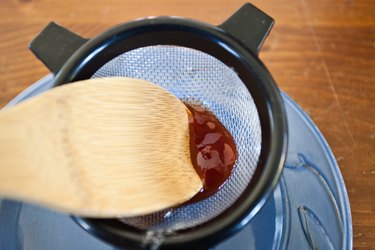
      Unlump your gravy with your sieve. Everybody says they make gravy with no lumps, but you know that's a lie. Incorporating flour into a roux or making a bechamel sauce is difficult, and sometimes you need a little help with quality control. Next time you make a gravy or a sauce, right before you serve it, give it a quick pass through your fine mesh sieve. Use a spatula to help push the sauce through, if it's thick. You'll find your track record with lumps will go from good to amazing.

    • 3

      Strain the juice and smoothies for the finicky drinker. He likes OJ with pulp, she likes it without... or maybe that old blender doesn't quite do the job pureeing all of the strawberries in that smoothie? Buy one carton of orange juice and pass one of the glasses through a fine mesh sieve for the finicky "no pulp" girl, and you've saved grocery money on that extra carton of OJ. Or give the smoothie a quick once over with the sieve before serving to ensure smooth consistency.

    • 4

      Clarify your broth. Making a stock or broth is a task for the patient, and no part of stock and broth making is more tedious than the clarification process. This can become infinitely easier if you give the broth or stock a quick strain with your fine mesh sieve. You need not even pour the broth through the sieve, actually. Using the handle, take the mesh through the broth three or four times, each time rinsing off the impurities it has picked up. You'll find the broth will be clearer in half the time.

    • 5

      Help decant that vintage wine. You're at a dinner party and you've just presented a Chateau Latour 1982 to your guests. You screw in the cork, pull it out and, to your horror, the cork shreds, leaving pieces floating in the wine. Not to mention, there's a good deal of sediment at the bottom of the bottle to contend with, as well. Not to worry! You fine mesh sieve will impart absolutely no flavor to this delicate wine, so as you decant it, pass it through the sieve. It will catch the pieces of cork, and keep the sediment from carrying on into anyone's glass.

Related Searches:

Comments

You May Also Like

  • How to Dry Molecular Sieves

    Chemists routinely use molecular sieves to dry --- that is, remove water from --- liquids and gases. A molecular sieve is a...

  • How to Buy a Fine Mesh Strainer

    An often neglected but indispensable kitchen utensil is the fine mesh strainer. This handy kitchen tool makes sure your reduction sauces are...

  • What Is a Sieve or Food Mill?

    Peeling and coring apples for applesauce, getting the seeds out of the blackberries for making jam, removing the skins and seeds from...

  • How to Use Zeolites to Remove Water From Alcohol Fuel

    Alcohol fuel is made by mixing gasoline with ethanol, an alcohol produced from the distillation of any plant. Ethanol is usually made...

  • How to Sieve Pottery Glaze

    Glazing is the final artistic step in clay pottery. Learn some tips from a pottery expert on how to sieve a large...

  • How to Save Egg Whites

    Egg whites are low in cholesterol, fat and calories, yet high in protein, making them an ideal ingredient in sauces, casseroles, baked...

  • How to Strain and Store Honey from a Beehive

    Even if you are a hobby beekeeper with only a few hives on your property, those will be enough to provide a...

  • DIY Decorative Wire Mesh Cabinets

    You can add style to your plain raised panel cabinet doors by installing decorative wire mesh inserts. You can do this by...

  • How to Save Duck Eggs When a Mother Dies

    Whether the mother duck has been killed or simply abandoned her nest, with your intervention, duck eggs can survive long enough to...

  • How to Juice Frozen Grapes

    The process of freezing and shipping grapes makes it possible for people in any climate to make their own grape juice for...

  • Kitchen Equipment Pre-Start Up List

    Kitchen Equipment Pre-Start Up List. When you're about to move into your first home, consider your kitchen shopping list carefully. The right...

  • How to Use Lemon Juice in Place of an Acid Blend

    Acid blends give wines their slightly sharp, crisp taste and balance the sweetness and bite of the wine. A good acid blend...

  • How to Make Paper Out of Leaves

    Making paper from leaves is a fun and easy nature craft that can be done with children of any age. Autumn colors...

  • What Is a Molecular Sieve?

    A molecular sieve is a manufactured crystal used to separate molecules of a particular size from a gaseous of liquid mixture. Commonly...

  • Soil Classification Methods

    Soil Classification Methods. Soil is a single substance or a mixture consisting of gravel, sand, clay, silt or organic matter. Soil scientists...

  • Homemade Sieves

    Sieves can be used to separate different substances from one another. You can make a homemade sieve from just about anything. Try...

  • How to Grow Poblano Peppers From Fruit Seed

    Poblano peppers, also known as ancho peppers when dried, are a mildly hot form of pepper. They provide an authentic Mexican taste...

  • How to Use Soapwort

    Saponaria officionalis, most commonly known as soapwort, goes by many names including bouncing bet, bruisewort, farewell summer, fuller’s herb, Joe run by...

  • Food Mill Substitutes

    Food Mill Substitutes. Food mills come in both electric and hand-crank models. Typically, food mills come with a variety of interchangeable stainless-steel...

Related Ads

Know Your Knives: Josh Ozersky’s Comprehensive Guide

I have a lot of knives. You probably do too. I really don’t know what to do with them all. There’s a Chinese cleaver, aï؟½

Featured