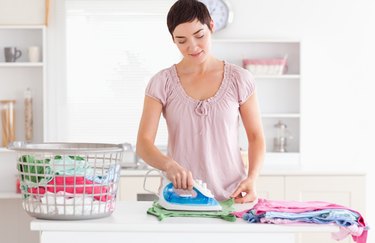
When Henry W. Seeley patented the electric iron in 1882, he changed the way people ironed clothes. Up until his invention, ironing was a hot and arduous task. Primitive metal flatirons had one temperature -- hot -- and it was a struggle to keep the base plate hot enough to smooth wrinkles. Your iron offers the choice of heat settings for you to use on the variety of commonly available fabrics; thus creating a new dilemma -- deciding what temperatures work best for which fabrics.
Determine the Type of Fabric
Video of the Day
When purchasing new fabric, read the end cap of the cardboard sleeve the bolt of fabric is wrapped around or the attached tag. Make a note of the type of fabric and any care instructions listed.
Video of the Day
Testing Your Iron
Iron temperature settings differ by manufacturer, but most have the heat settings for each type of fabric printed on the temperature dial. Nevertheless, it's important to test a hot iron on a scrap of fabric first before ironing any large pieces for your project. Your iron may run a little hotter or cooler than what is needed. Adjust your iron temperature accordingly. You want a temperature hot enough to smooth the wrinkles, but not so hot that it damages the fabric. If temperature is critical, use a thermocouple and a multimeter to test your iron.
Heat Settings for Fabrics
Use these basic iron temperature setting guidelines for your fabrics: acetate, 290 F; acrylic or nylon, 275 F; cotton, 400 F; linen, 445 F; polyester, silk or wool, 300 F; rayon, 375 F; triacetate, 390 F. For blended fabrics, use the lowest temperature recommended for the fibers in the blend.