How to Make Basic Drawstring Pants or Shorts That Fit

By Ursula Anderson

You can also use elastic instead of a drawstring. You can also use elastic instead of a drawstring.

Rate: (5 Ratings)

Warm weather is on its way, and maybe you are tired of the same old pants and shorts hanging in the closet--I know I am! But sometimes new clothes are too expensive, or they are made from inferior fabric, or you have a hard-to-find size. This method of making your own pattern for custom-fitted pants or shorts can solve all those problems! Even a beginning seamstress or tailor, even without a sewing machine, can make acceptable pants this way, and an experienced seamstress or tailor can make elegant, sophisticated ones. What do you have to lose?! Give it a try!

Instructions

Difficulty: Moderate

Things You’ll Need:

  • A flexible measuring tape
  • Sharp scissors for fabric
  • Crappy scissors for paper
  • Chalk or other non-permanent fabric marker
  • Big paper (even taped-together newspapers will work for this, but it's easier if the paper is plain, like grocery bags or butcher paper)
  • A writing/drawing implement for the paper, such as a pen, marker, pencil or crayon
  • A pair of pants or shorts that fits well in the crotch
  • lots of straight pins
  • 2 1/2 to 3 yards of fabric for long pants, or 1 1/2 to 2 yards for shorts
  • Needle and thread
  • Elastic or a suitable drawstring, which you can buy or make from a long, narrow piece of the fabric
  • A large cutting/measuring surface, such as a dinner table or a clean patch of floor
  • small pad of paper to record measurements
  • About 2 hours
Step1
Make sure you have a flexible measuring tape. Take measurements. Start by sitting down on a straight chair, like a kitchen chair. Hold the measuring tape at your waist in front, then tuck it between your legs and measure the length between the front of your waist and the back. This will be the crotch measurement, and it is one of the most important measurements for a good fit. Write it down on your small pad of paper, labeling it, "Crotch."
Step2
Measure twice, cut once. Measure your hips at the widest part. Hold the end of the tape measure at your hip, and pass it horizontally around till it meets up in the front. Write this down, labeling it, "Hips." This will be your waistline, because you have to be able to get them on, and usually people's
Step3
Measure from your waist to your ankle, or wherever you want the length of the pantleg to end, then add 2 1/2 inches to this to make room for the drawstring or elastic to go through, and for the hem. Write this down, labeled, "length."
Step4
On your piece of paper, draw a straight line vertically down the middle of the piece of paper. At the top edge of the paper, draw a line, horizontally, the length of your waist measurement, divided evenly on both sides of the line.
Step5
Divide the crotch measurement by 2. For instance, if your measurement is, say 24 inches, the divided measurement would be 12 inches. Measuring that number of inches below the waist line you just drew, draw a line parallel to the waist line. Label it, "Waist."
Step6
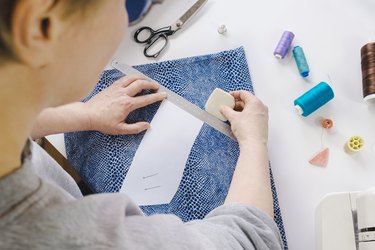
This is a very important measurement for the final fit. Take the pair of pants that fits you, and fold it in half at the crotch, longways, so you can see the curve it makes from the waist to the point the crotch makes. Trace that line, first on one side of the line, then the other, so you have a horizontal waist line, a horizontal crotch line, then a curved line connecting them. Add half an inch seam allowance the length of the crotch line.(see illustration)
Step7
The inseam can be long or short, depending on what you're making. Draw a line from the point of the crotch to the cuff of the pants or shorts. If you are making pants, this will be the length of the inseam. If you are making shorts, this will be the length the finished shorts will be. Be sure to leave a little extra for the hem.
Step8
Doesn't look much like pants yet, does it? Your final pattern should look sort of like a sleeveless top. It's okay; it's supposed to look like that. The final pants or shorts will be folded in half and sewn at the inseam after the crotch is sewn. Cut out the pattern, following the lines you made on the paper.
Step9
Lots of fabric choices! Fold your fabric in half width-wise, so the fold is at the top. Make it as even as possible. Pin the pattern securely to the fabric, with the Waist line at the top fold of the fabric. Make sure not to let the fabric get too wrinkled or messy under the pattern, because that can affect the lines you cut when you cut the fabric.
Step10
The cutting is more crucial than the sewing. Cut carefully! Leaving the pattern and fabric pinned together, carefully cut around the pattern, so you make two pieces shaped exactly the same, pinned together. Be sure to cut across the top waist line so it is an open place, making it possible for you to put on the finished product.
Step11
Remove the pattern, without disturbing the position of the pins. You need the fabric to stay pinned together without keeping the pattern on top of it. You CAN sew right through the pattern, but if you intend to re-use it, it's best to remove it carefully before you start sewing.
Step12
Sew neatly and evenly so the crotch doesn't bunch and wrinkle. On each side of your cut out pattern pieces will be a curved Crotch line. Sew along each side, half an inch from the edge.
Step13
Unpin the joined cut-out fabric pieces. Fold them until the crotch seams lie one on top of the other and match up perfectly.
Step14
Sew the inseams on the pantlegs. Pin and sew the inseams, which are directly below the crotch.
Step15
Pin and hem or sew the cuffs of the pants, or pull horizontal threads out to make a fringe.
Step16
Room for elastic or a drawstring. Fold the waist down an inch and sew all the way around, leaving about an inch open above the front crotch for threading the elastic or drawstring through. If elastic is used, sew the final inch closed. If using a drawstring, divide the leftover inch in two at the crotch seam and allow to remain open. Stitch the loose ends down, but make sure there is room to pull the drawstring through each side for tying.
Step17
Elastic. Pull the drawstring or elastic through the channel you have just made. Either sew shut, or not, referring to the above step. Your basic pants are done!

Tips & Warnings

  • You can embellish the pants or shorts in many different ways: embroider them, add patch pockets, beads or sequins, or grosgrain ribbon stripes.
  • Once you've made a basic pair of pants or shorts, it's easy to see how to change the width or length of the legs. Be sure to experiment!
  • Don't EVER use the same scissors you use to cut fabric to cut paper. Paper will dull your scissors instantly, and will make them very hard to sharpen again. Use cheap, crappy scissors for paper unless you are an artist. Save fabric scissors for fabric AND NOTHING ELSE.

Comments

| View All Comments
Gracie1402

Gracie1402 said

Flag This Comment

on 5/7/2008 These look easy enough, thanks for the great idea! 5 stars!

leannec71

leannec71 said

Flag This Comment

on 5/3/2008 Wow cool I like this idea I need to get my sewing machine fixed and soon. Thanks

Post a Comment

POST A COMMENT

Request a New How-To Article

Looking for more How To information? Chances are there’s an eHow member who knows how to do what you’re looking to do. Submit an article request now!

eHow Article: How to Make Basic Drawstring Pants or Shorts That Fit

Related Ads