eHow launches Android app: Get the best of eHow on the go.

How To

How to Crochet the Diagonal Box Stitch

Contributor
By eHow Contributing Writer
(3 Ratings)

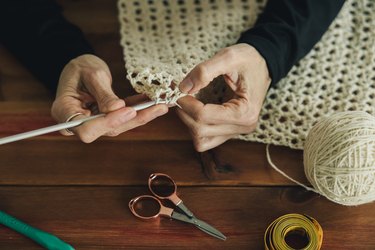
The most common crochet projects are afghans. While you can find many different afghan patterns, most are a variation on the theme of horizontal stripes. If you're looking for a bit of a change, you can try the diagonal box stitch. With this stitch, you end up working your projects in slanted diagonal rows. You can use it to create diagonal stripes or to create an interesting texture in single color project.

Difficulty: Moderate
Instructions

    Start Your Afghan

  1. Step 1

    Make the first two rows. Tie a slipstitch onto the crochet hook and chain 6 chain stitches.

  2. Step 2

    Double crochet in the 4th, 5th and 6th chains from the hook, which we'll call an "increase group." Repeat the "increase group."

  3. Step 3

    Flip the bottom of the first group of stitches up to meet the hook. Insert your hook into the 3rd chain of the first group of stitches and slip stitch the two sections together to finish the first box.

  4. Step 4

    Chain 3 and do 3 double crochet stitches in the 3 chain stitches you used for the slip stitch.

  5. Begin Increasing

  6. Step 1

    Do an "increase group," flipping your previous two rows up as you did in Section 1.

  7. Step 2

    Insert your hook into the 3-chain group from the ending of the second row and join the two groups with a slip stitch.

  8. Step 3

    Chain 3 and do 3 double crochet stitches in the 3-chain group of the previous block, by the slip stitch, which we'll call a "slip stitch group."

  9. Step 4

    Place your hook in the 3-chain group of the next block and repeat the "slip stitch group". You're finished with this third row.

  10. Continue Your Afghan

  11. Step 1

    Repeat Step 2 for the 4th row and subsequent rows. You'll start each row with an increase group, flip it up and then follow it with "slip stitch groups" until you reach the end of the row.

  12. Step 2

    Realize that row 4 will have one increase group and three slip stitch groups; row 5 will have one increase group and four slip stitch groups and so on.

  13. Step 3

    Continue in this fashion until the side of your project reaches the desired width.

  14. Begin Decreasing

  15. Step 1

    Mark the end of the project thus far with a different colored yarn to save confusion during flipping.

  16. Step 2

    Decrease by first chaining 1 and then turning the project as in normal crocheting, not flipping as in previous rows.

  17. Step 3

    Slip stitch in the following 3 double crochet stitches, slip stitch under the 3-chain group, chain 3 and and stitch three double into the same 3-chain group. We'll call this the "decrease group."

  18. Step 4

    Continue with "slip stitch groups" until the end of the row.

  19. Complete Your Afghan

  20. Step 1

    Do an increase row. Start with the "increase group," flip and continue with "slip stitch groups" to the end of that row.

  21. Step 2

    Alternate decreasing and increasing rows until you reach your desired length.

  22. Step 3

    Add a border if desired. This stitch doesn't give a nice looking edge, so a border of some sort around the outside of the project will make it look nicer.

Comments  

sbrattsmom said

Flag This Comment

on 9/10/2008 Don't know if this is going to be posted twice or not. If it is,, I do appologise. It was not suppose to be.
My question is,,How do you "carry" yarn in a pattern ,,when there are several other yarns. Is there any infro. that I can find?? Thanks in advance. Please
contact: sbrattsmom@aol.com

sbrattsmom said

Flag This Comment

on 9/10/2008 I do not know how you "carry" your thread in crochet patterns. Where do I find some infro. on this?
sbrattsmom@aol.com

Subscribe

Post a Comment

Post a Comment

Related Ads

  • Have you done this? Click here to let us know.
I Did This
Get Free Hobbies, Games & Toys Newsletters

Copyright © 1999-2009 eHow, Inc. Use of this web site constitutes acceptance of the eHow Terms of Use and Privacy Policy.   en-US Portions of this page are modifications based on work created and shared by Google and used according to terms described in the Creative Commons 3.0 Attribution License.

eHow Home and Garden
eHow_eHow Home and Garden