Things You'll Need:
- scrap paper (8x11 is best)
-
Step 1
Remove any thread from your sewing machine; you will first be learning to guide the material and sew lines and shapes. Raise the presser foot (there will be a lever or button on the machine to do this). Raise the needle by turning the hand wheel towards you. Place a piece of paper beneath the needle with the bulk of the page close to you. Lower the needle into the paper, again by turning the hand wheel, and lower the presser foot.
-
Step 2
Place your fingertips on the paper one hand on each side of the needle. Your wrists should be bent so your hands turn inward, and your fingertips either parallel or slightly angled to the line you are about to sew. You will find a comfortable position for your fingertips as you practice more. Your fingertips will guide the 'fabric', but should not push or pull, so maintain a light touch.
-
Step 3
Press gently on the foot pedal to begin the motion of the needle. The amount of force on the pedal will determine the speed of sewing. Guiding the paper, try sewing a straight line down one side of the page. (The needle holes in the paper will show how accurate you are.) When you get to the bottom of the page, stop the sewing machine, raise the presser foot, turn the paper 180 degrees, and sew another straight line this time sewing faster.
-
Step 4
Practice turning corners by sewing a short straight line, then stop the machine with the needle still down (holding the paper). Lift the presser foot, turn the page 90 degrees, lower the presser foot and continue sewing.
-
Step 5
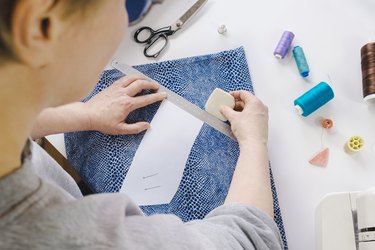
Practice seam allowances by sewing the straight line 3/4 inch from the edge of the page. Many sewing machines have a seam allowance guide on the lower arm of the machine. If you don't have an attached guide, use a measuring tape and starting at the point of the needle measure to the right 3/4 inch, or whatever width you need. I recommend marking this measurement by placing the edge of straight sided magnet at the right point. You could also use a pen or fine tip permanent marker to mark the measurement. A standard seam allowance is 5/8 inch, so you will want to practice this width as well.
-
Step 6
Practice curves by starting with a new piece of paper. First use a pencil to draw a large circle or a moderately wavy line on the page. Place the paper under the needle and lower the needle on the line you've drawn. Sew slowly, guiding the paper to get as smooth of a curve as possible. Again, practice going faster as well.
-
Step 7
When you are ready, try these same steps with fabric. I recommend using a single layer of unbleached muslin fabric because it is easy to guide and inexpensive. Use dark thread so you can better see mistakes. Thread the machine according to manufacturer's instructions. You should have two thread ends, one from the needle eye and one from the bobbin, pull these away from you and left of the needle with at least 3 inch tails of thread. (If the excess thread is too short, your needle may un-thread when you start sewing).
-
Step 8
Finally, using two layers of fabric, try sewing pieces together.


Comments
stormigrl said
on 6/30/2009 I haven't sewn in a long time and I am trying to get back into it. Since my husband bought me a Brother sewing machine for my birthday, he's been using it more than I have. And I want to sew a skirt. I already have the fabric, and the idea, just need a starting guide.
Hmm Useful info.
Sorry I wasn't able to give you a star rating. The star rating thing comes up after we post.
5 stars column.
Thanks.
tresure0 said
on 6/16/2008 this should help me out with my "first time" again worries. Thanks!
knitty-corner said
on 3/11/2008 i just got a machine and have no clue what i'm doing. this is a very helpful start.