How to Make a Knitting Basket
If you're tired of housing your skeins of yarn and knitting needles in a box, bucket or tote bag, consider making a knitting basket. This basket isn't a traditional basket made from reeds. Instead, it consists of two X-shaped wooden frames on either side of a heavy fabric bag. The frames provide a sturdy base that won't collapse. The fabric bag is roomy and soft, leaving you with plenty of storage space without worry of your yarn becoming snagged.
Things You'll Need
- 1 yard heavy fabric, 42 inches long
- Fabric measuring tape
- Fabric pencil
- Scissors
- Straight pins
- Sewing machine
- 4 hardwood boards, 1/2 inch by 7/8 inch by 18 inches
- Measuring tape
- Pencil
- 5/16-inch drill bit
- Electric drill
- Scrap wood block
- Sandpaper
- 2 bolts, 5/16-inch with washers and nuts
- 4 dowels, 5/16 inch by 15 1/2 inches
- Wood glue
Instructions
-
Bag
-
1
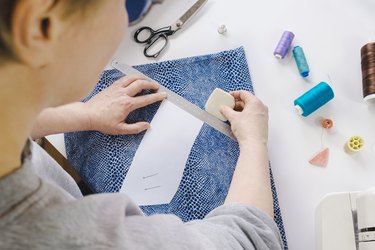
Spread out 1 yard of heavy fabric that is 42 inches wide on a flat work surface with the wrong side facing up. Measure a 14-inch by 40-inch rectangle and a 10-inch by 36-inch rectangle on the surface of the fabric using a fabric measuring tape. Mark the rectangles on the fabric with a fabric pencil. Cut out both rectangles with scissors.
-
2
Lay the larger rectangle wrong side up on the work surface. Fold one of the shorter edges inward 2 inches. Ensure that wrong sides of the folded fabric are together. Pin along the straight edge of the folded flap with straight pins. Repeat along the opposite short edge of the rectangle.
-
-
3
Sew a 1/2-inch seam along the pinned edge of each fold with a sewing machine. Remove the pins before sewing over them to avoid breaking your machine's needle. Clip any loose threads. You should now have a 1 1/2-inch wide casing or tube at either end of the rectangle.
-
4
Lay the smaller rectangle, wrong side up, on your work surface. Fold one of the shorter ends inward 1/2 inch and pin in place. Repeat on the opposite end. Sew a 1/4-inch seam along the folded edges. Remove the pins and clip any loose threads.
-
5
Lay the larger rectangle, wrong side up, on the work surface. Position this rectangle horizontally on the surface with the ends containing the casings on the left and right. Lay the smaller rectangle, wrong side up, vertically on top of the larger rectangle. Position the smaller rectangle in the center of the larger rectangle with its hemmed ends on the top and bottom. Pin along the portion of both lengthwise edges of the smaller triangle that overlap the larger triangle. The fabric should form a cross-like shape.
-
6
Sew a 1/2-inch seam along the two pinned edges to join the fabric rectangles together. Remove the pins and clip any loose threads. Spread the fabric out on the work surface with the wrong side facing up.
-
7
Lift up the center rectangle of the fabric where the two pieces cross. The flaps should fall down to create a box-like shape. Pin the corresponding edges of the flaps together to hold this shape. Sew a 1/2-inch seam down each pinned edge, beginning one inch down from the center rectangle and moving toward the open edges. Remove the pins and clip any loose threads.
-
8
Turn the box or bag right side out. Ensure that there is a 1-inch open space in each bottom corner of the bag and that two of the bag's top edges are shorter than the edges with the casings.
Frame
-
9
Lay four hardwood boards that are 1/2-inch by 7/8-inch by 18-inches side by side on a flat work surface. Unroll a measuring tape along the length of the first board. Make marks in the center of the board at the one-inch, nine-inch and 17-inch points with a pencil. Repeat this step with the three remaining boards.
-
10
Place a 5/16-inch drill bit in an electric drill. Select the first board and place it on a scrap block of wood. Drill three holes in the board at the markings. Repeat this step with the remaining three boards. Smooth the edges of the drilled holes and ends of each board with a piece of sandpaper.
-
11
Select two boards and stack one on top of the other. Line up the three holes in both boards. Insert a 5/16-inch bolt through the center hole of each board. Flip the boards over so that the end of the bolt is protruding upward through the holes. Pull the boards open into an "X" shape. Position the top ends of the two boards roughly nine inches apart. Place a washer on the end of the bolt and then a nut. Screw the nut on tightly to tighten the boards together. Repeat this step with the remaining two boards.
-
12
Lay one of the "X" shaped frames face down. with the top of the bolt against the work surface. Apply wood glue over one inch of one end of a 5/16-inch by 15 1/2-inch wooden dowel. Insert the glued end through a hole in one end of the frame. Repeat this process with the three remaining dowels, adding one dowel into each of the three remaining holes in the frame.
-
13
Pick up the fabric bag. Insert one end of the two top dowels into the opening of each of the bag's casings. Insert one end of each of the bottom dowels into the 1-inch openings at the bottom of the bag. Push the bag down onto the dowels until their ends appear out the other sides of the casings. Thread the ends of the bottom dowels through the 1-inch holes on the other side of the bag.
-
14
Apply wood glue to the top of each dowel, spreading it down the dowel about one inch. Hold the second "X" frame right side up above the dowels. Insert the ends of each dowel through its corresponding hole in the frame. Turn the knitting basket right side up and allow it to sit for one to two hours so that the wood glue can dry.
-
1
References
- Photo Credit Hemera Technologies/PhotoObjects.net/Getty Images