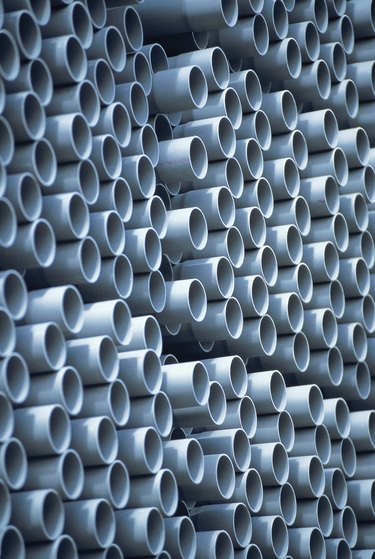
Polyvinyl chloride (PVC) pipe is usually manufactured from solid PVC. Compared to traditional metal pipes, PVC pipes are cheaper and lighter at the expense of strength. In many applications, the strength loss has no bearing on function. PVC foam core pipe uses an alternative means of manufacturer. Rather than making the pipe from solid PVC, a blowing agent, azobiscarbonamide, is used to blow a foam core in between two thin PVC walls. It looks and functions very similar to PVC pipe, but has a few differences.
PVC Foam Core Pipe Structure
Video of the Day
PVC foam core pipe is manufactured in three layers. The top and bottom layer are solid PVC compound, which is identical to the material in solid PVC pipes. Rather than forming a single pipe, a skin is made for the exterior and interior surfaces of the pipe. PVC foam core pipe is not porous, as a result of these skins. The blower agent is channeled between the two layers to form the foam core within the pipe.
Video of the Day
Property Changes
The foam core slightly alters some of the properties of the PVC foam core pipe in comparison to solid PVC pipe. The foam core pipe is less rigid, which means it lasts up to 10 years longer than solid pipe before it needs to be replaced. The core insulates sound, which can dampen unwanted noise within a building. The temperature range in which PVC foam core pipe can be used is slightly larger, but not to a significant enough degree to typically be an advantage.
Compared with Traditional PVC Pipe
The main difference between PVC foam core pipe and solid PVC pipe is cost. PVC foam core pipe is significantly cheaper for the same length of pipe. The actual materials used to make foam core pipe are slightly more expensive per pound, but PVC foam core pipe is lighter. It takes less material to make the same length of pipe, resulting in a net reduction in manufacturing cost. The additional properties are beneficial, but usually not the primary motivation factor for using foam core pipe.
Usage
PVC foam core pipe can be used in almost every application in which solid PVC pipe is used. Many of these applications, such as holding electrical wires or drainage, do not require much strength. Some water, irrigation and chemical pipes also can be made with PVC pipe. Typically, PVC pipe is only used in smaller scale applications. It is often used in construction projects for water and drainage piping. It is less commonly used in large scale, industrial applications.