- Despite the name, the Dyson Animal Vacuum is not designed to be an alternative to bathing your dog or cat. It's simply made with cleaning up pet hair and dander in mind, along with all the other dirt and debris that gets ground into the carpet of any typical household. The Dyson Animal Vacuum comes in many models, including canister vacuums and handheld designs. The standard upright style is by far the most popular of the Dyson Animal Vacuum line for its Root Cyclone suction system and HEPA filters.
- The Dyson Animal Vacuum runs in a fashion similar to most upright vacuums. There's an internal electrically powered motor set at the center of the joint between the floor head and the canister sitting atop it, not unlike sitting at the joint of the letter "L." The motor runs two separate processes. The first is the beater bar assembly. This is a long, plastic cylinder set into the head of the vacuum, right behind the ports into which debris is sucked. This cylinder is set parallel to the ports, like a rolling pin. Set into the body of the beater bar are a series of stiff, bristly brushes. Connected to the motor via an endless belt, the beater bar spins, striking and vibrating carpets to push dirt up to the top where it can be pulled in by the vacuum's suction. The suction is generated by a large fan set into the base of the canister, looking like a large fan. From the ports at the base of the floor model head, air is pulled in through a ribbed tube to the top of the canister, down through the root cyclone system. The root cyclone system divides the pipe into multiple ports. In this way a large object being pulled up through the pipes will not block the flow of air and impede further suction. Air then passes through the fan and several layered air filters to exit out the back. Debris the air carries would be caught before it reached the fan, though smaller materials would end up in the filters.
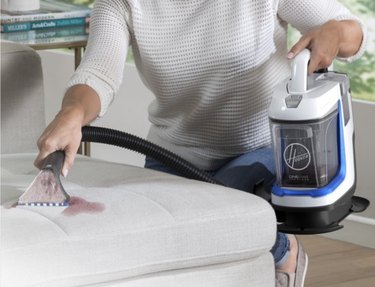
- The ribbed suction pipe running from the top of the root cyclone port to the floor model head can be detached. When it is detached, a small catch at the base of the head recognizes this and turns off the beater-bar assembly while retaining suction to the suction pipe. In the same way that the suction pipe can be attached to the floor model head, it can be plugged into the back of a handheld attachment containing a miniature modified beater bar. The beater bar has fins along its length which are caught as the pipe sucks in air, causing it to spin like its larger counterpart. This spinning action brushes against a given surface, pulling up dirt through any sort of fibrous weave until the force of the suction can get it. In this way curtains and furniture can be cleaned as thoroughly as the floor.