eHow launches Android app: Get the best of eHow on the go.

How Does

How Do Treadle Sewing Machines Work?

Contributor
By John Albers
eHow Contributing Writer
(0 Ratings)

    Operating the Treadle

  1. The treadle sewing machine was the precursor to the modern electric-powered sewing machine. If you were to pry the casing off a modern-day sewing machine, you would not see much difference in the function or design as compared to the older models made prior to electricity. The primary difference is the motive force. Without electricity, a user would power the sewing machine by means of a treadle. A treadle is essentially a large rocker peddle that tips back and forth by applying pressure with the toe, and then the heel. A push rod connected to the side of the treadle is moved up and down by this continuous motion. The top of the push rod is connected to a flywheel, which is turned in a continuous circle by this up and down motion. Connected to the flywheel is a leather belt, which is also connected to the main crankshaft at the back of the sewing machine proper.
  2. The Upper Drive Shaft

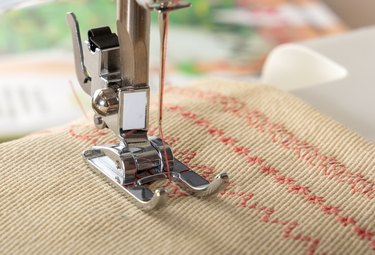
  3. The drive shaft splits its motive force in two, powering both a lower and upper drive shaft. The upper drive shaft travels along the upper length of the sewing machine, parallel with the work surface where clothing is sewn. It culminates in the form of a large crank connected to the needle bar. At the top of the machine's head is placed a spool of thread. The thread is passed down the length of the needle bar into the slotted needle at its base. When the treadle is pushed, the needle bar rises and falls, passing the needle through the cloth into the underside of the machine, where it works in conjunction with the hook and bobbin, which are parts of the lower driveshaft assembly.
  4. The Lower Drive Shaft

  5. The lower drive shaft is connected to the upper drive shaft via pulley, and resides underneath the table surface of the sewing machine. It runs parallel to the surface, and ends in the form of a rotary crank shaft just beneath the point where the needle dips under the sewing table. This rotary crank shaft is connected to a hook and bobbin assembly. The hook and bobbin may best be described as circle of metal broken at a specific point with a shaped hook at the leading edge. When the needle drops down in range of the hook, it turns, hooking the thread running through the needle. It continues to turn a full circle, passing the thread in a circle to form a loop. The needle passes another length of thread through the loop to form a stitch, and the hook catches that next length of thread to repeat the process.
Subscribe

Post a Comment

Post a Comment Post this comment to my Facebook Profile

eHow Article: How Do Treadle Sewing Machines Work?

Related Ads

Get Free Hobbies, Games & Toys Newsletters

Copyright © 1999-2009 eHow, Inc. Use of this web site constitutes acceptance of the eHow Terms of Use and Privacy Policy.   en-US Portions of this page are modifications based on work created and shared by Google and used according to terms described in the Creative Commons 3.0 Attribution License.

eHow Hobbies, Games and Toys
eHow_eHow Hobbies, Games and Toys