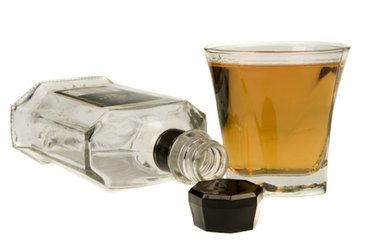
To describe the difference between Bourbon and whiskey, many distillers and experts say that although all Bourbon is whiskey, not all whiskey is Bourbon. Bourbon is made according to specific standards and with specific ingredients. Bourbon is named for where it was first produced -- Bourbon County, Kentucky in the Bluegrass Region. When it was shipped, it was marked with the name of the county and soon became known by the name.
Whiskeys and Bourbons
Video of the Day
Tennessee whiskeys like Jack Daniel's are similar to Bourbon. Some are served as Bourbon, but they have a different filtration process and are not Bourbon. Kentucky Bourbon must be aged in Kentucky to be known as such. Kentucky straight Bourbon whiskey must not be blended with whiskeys made outside Kentucky. American whiskey is that which was not aged or bottled in Kentucky or Tennessee, and Kentucky whiskey is that which does not meet the standards of Bourbon. There are also rye whiskeys, which contain at least 51 percent rye grain, and Scotch whiskey is made from barley.
Video of the Day
Indian Corn
To qualify as Bourbon, a whiskey must be made from at least 51 percent Indian corn but cannot exceed 79 percent. If it exceeds 79 percent it is corn whiskey and not Bourbon. Other whiskeys are made from at least 51 percent rye, wheat, malt or rye malt. Other mixtures included in the Bourbon must be the same types of whiskey.
New Oak Barrel
To be Bourbon, a distilled spirit must be aged for at least two years in new oak that has been charred on the inside. It is very important legally that the barrel must be new, but the Bourbon is usually aged for four years rather than two. The barrels used can be made from any kind of oak, but distillers most often use American white oak to distill Bourbon because of the wood's porosity. The porosity of American white oak helps the Bourbon to age well, but it is not so porous that the barrels leak. Whiskey, along with Scotch and other distilled spirits, is generally aged in used barrels.
Bourbon Contains No Foreign Whiskey
Alcohol, Tobacco and Firearms standards for distilled spirits state that Bourbon cannot be produced with any spirits distilled in a country other than the United States. These same standards also state that the term Bourbon cannot be used to describe any whiskey or whiskey-based distilled spirits produced in a foreign country. If foreign whiskey is used, the percentage of foreign whiskey and the country in which it was produced must be on the brand label.