Beeswax Wood Treatment

Beeswax Wood Treatment thumbnail
Beeswax is an excellent wood treatment,

Beeswax has been used to treat and protect wood as long as there have been wood products. Beeswax protects just about anything from wood to cloth from the destructive effects of moisture. Alone it provides a strong, water-resistant coating for any wood product, especially those used in kitchens. Beeswax is a natural, food-safe material. It can be combined with other edible or inedible oils to provide other treatment qualities.

  1. History

    • The Catholic Church once required beeswax candles.
      The Catholic Church once required beeswax candles.

      Beeswax was regarded as a sacred material by the Catholic Church. The church once required beeswax to be used in all candles made for the church. According to pioneerthinking.com, Homer, a Greek poet, wrote about beeswax being used as a wood treatment in the middle ages. It also has been used as money. Egyptians used beeswax to make death masks, embalm bodies and form statues of gods to place in graves.

    Benefits

    • Food on a treated cutting board
      Food on a treated cutting board

      Beeswax is a completely natural substance. It is the end product of the collection of pollen by the worker bees in a hive. Beeswax is extremely easy to use. Blocks of beeswax can simply be shaved into a double boiler and used by itself as a wood treatment. Because beeswax is a thick material, it fills up the natural pores in wood. This characteristic blocks bacteria and small particles from remaining in wood blocks. Water cannot remain in or on the board, so bacteria cannot survive.

    Beeswax as a treatment

    • Beeswax is used on antiques.
      Beeswax is used on antiques.

      Beeswax can be used alone, without any other oils. Beeswax is usually purchased in blocks of various shapes. When it is used alone, the wax is melted slowly in a double boiler over low heat. The beeswax is shaved off the block in very thin slivers to make melting easier. The warm beeswax is then applied to the wood to be treated in small amounts with a soft cloth. When it is used alone, it treats wood as a topcoat only. It does not soak into the wood.

    Use of beeswax with inedible oils

    • Beeswax can combine with inedible oils.
      Beeswax can combine with inedible oils.

      Combinations of beeswax with other inedible oils are used to treat wood with a beeswax topcoat while the oil soaks into the wood. This mixture is used on furniture or other objects that will not be used with food. Materials commonly used with beeswax to treat wood are turpentine and linseed oil. According to esoulshine.com, those three materials are mixed with melted beeswax in equal amounts. The resulting wood treatment is then stored in jars for later use.

    Beeswax food-safe treatment

    • Walnut oil can combine with beeswax.
      Walnut oil can combine with beeswax.

      Many wooden kitchen utensils are treated with a combination of beeswax and food-safe oils. Two of the most common oils are walnut oil and mineral oil. Walnut oil is the only plant-based oil that will not become rancid. According to woodweb.com, one part mineral oil is mixed with five to six parts beeswax. Canaryreport.org gives a formula for recipes with walnut oil as two parts beeswax to one part walnut oil.

    Applying any beeswax wood treatment

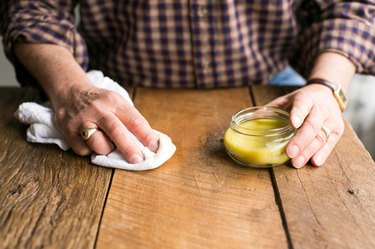
    • All beeswax wood treatments are applied in small amounts. A soft cotton cloth is usually used, because it does not leave lint. A very small amount of the wood treatment is picked up on the cloth. The beeswax wood treatment is then rubbed into the wood until all of it has been rubbed in. This procedure is continued until the piece is entirely covered. The treatment will dry into a hard coat. A second coat may be applied when the first is dry.

Related Searches:

References

Resources

  • Photo Credit Cells for honey image by amlet from Fotolia.com vela 1 image by Nuka from Fotolia.com cut bread roll and cheese image by Warren Millar from Fotolia.com antique desk image by Leticia Wilson from Fotolia.com miel et cuillére image by Philippe LERIDON from Fotolia.com three sorts of oil image by Tomo Jesenicnik from Fotolia.com

Comments

You May Also Like

  • How to Treat Wood for Use As a Countertop

    Wooden countertops are a warmer, rustic-feeling alternative to metal, laminate or stone countertops in kitchens. Because wood is porous, proper treatment and...

  • DIY Natural Wood Sealant

    Sealant is beneficial for any type of wood item, especially for outdoor wood and wood furniture indoors that may come in contact...

  • How to Finish Wood With Walnut Oil

    Walnut oil magnifies the beauty of wood furniture and flooring, while adding a protective finish. Unlike many finishes, walnut oil is all...

  • How to Use Walnut Oil As a Finish

    You can use walnut oil to leave wood surfaces with a natural-looking finish. Purified natural oils such as walnut oil often are...

  • How to Remove Beeswax From Wood

    Beeswax has been used many years as a sealant and finish for wood works, wood flooring and wooden furniture. If for one...

  • Beeswax Uses With Wood

    Beeswax Uses With Wood. Beeswax is a wax that honeybees create naturally and use to build the honeycomb structure in which they...

  • How to Age Furniture Using Beeswax

    Long before wood furniture was covered in shiny finishes like varnish, shellac and polyurethane, beeswax was used. Beeswax gives wood furniture a...

  • Homemade Wood Preservatives

    You can protect natural wood from inevitable deterioration in many ways. Paint stores offer wood finishes for indoor and outdoor use, but...

  • How to Apply the First Coat of Wood Lacquer

    A good lacquer finish brings out the rich depth and inner beauty of a piece of wood in ways that other clear...

  • Beeswax Recipes

    Beeswax is a beneficial by-product of the honey-making process. Its skin-soothing qualities have been known for centuries. It provides a longer-lasting, brighter...

  • How to Make Wood Finish

    A walnut oil and beeswax blend is an environmentally friendly alternative to other wood finishes. Walnut oil is available at your local...

  • How to Apply a Beeswax Finish

    Beeswax finish was used over 100 years ago to protect and decorate wood floors and furniture. It can still be found today...

  • Skin Benefits of Beeswax

    When constructing a honeycomb, bees secrete a nutrient-rich substance called beeswax. Utilized in a variety of skin care products, beeswax improves the...

  • How to Make a Stain That Will Mix With Beeswax

    Wood stain is costly and is generally made from hazardous materials. Making your own stain from beeswax, walnut oil and natural turpentine...

  • Environmentally Friendly Termite Treatment

    The need for environmentally friendly termite treatment options has been a topic of great interest to many people in recent years. Pesticide...

  • How to Refinish Floors With Beeswax

    Made by bees as a storage system to hold their honey, beeswax is hard and has a high temperature melting point. By...

  • What Are the Treatments for Wooden Cutting Boards?

    Wooden cutting boards are beautiful, practical and economical, but they are not without care. If you want to have that favorite cutting...

Related Ads

Featured