

Types of Tachometers

Table of Contents
Types of tachometer include analog, digital, contact and non-contact units. Some are handheld and use laser light and electronics to take readings from a distance; others are purely mechanical. Regardless of type, they all measure the rotation speed of machinery, such as motors and engines.
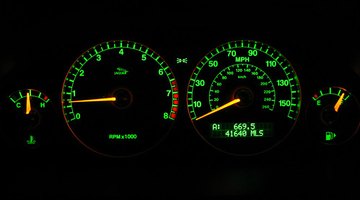
A tachometer's job is to measure the rotation speed of machinery, helping you determine the efficiency of production equipment or the safe operation of engines for your business. Tachometers (or "tachs") come in several different types. Some measure by mechanical means, others are electronic. Handheld tachometers are convenient and portable.
Uses for Tachometers
Machinery typically has an optimal working speed; if it’s running too fast, it might suffer damage. If it’s running too slow, there might be a problem with the machine or its power source. For example, poor lubrication, mechanical friction or too great of a load might be slowing it down. A tachometer accurately indicates the machine’s speed.
Tachometers and Speed
Tachometers measure the speed of rotating machinery, such as an engine, propeller or drive shaft. Most commonly, they indicate speed in revolutions (or rotations) per minute (RPM); some show revolutions per second (RPS). Some tachometers measures surface speed, such as the outer edge of a rotating wheel, in feet or meters per minute.
Types of Tachometer
Tachometers may be mechanical or electronic. Mechanical tachometers use electrical and magnetic forces to measure rotation speed; though they employ principles of electricity, they don’t need batteries. Electronic tachometers use electronic circuitry such as digital counters to determine RPMs. They use electric power, so they require batteries or other sources of current.
Contact and Non-Contact
A contact tachometer touches the rotating part you’re measuring. The part and the tachometer's sensor have the same speed, ensuring accurate results. A non-contact sensor uses light from a laser to illuminate a mark on the rotating equipment. A light sensor on the tach detects the movement of the mark. This kind of measurement can be safer and more convenient than the contact type since you don’t need to touch a running machine, though the mark must be clear and distinct to get accurate results.
Digital and Analog Tachometers
A digital tachometer reads out as a simple number, typically revolutions per minute (RPM) or second. An analog tachometer has a dial and needle pointer; at zero RPM, the pointer is typically at the zero mark, about 7 o’clock on the dial. For convenience and readability, some digital tachometers also have an analog-like display with a round “dial” and the image of a pointer that indicates speed. Another example is a horizontal or vertical bar, the length of which varies with the measured speed.
Advantages and Disadvantages of Digital Tachometer
Digital tachometers display an exact number which is the RPM speed; slight changes in RPMs are immediately apparent. They may have a “hold” feature that temporarily keeps the last reading, giving you time to write it down. However, being electronic, they need batteries. Also, numeric displays are slightly less easy to read than analog dials, especially if you want to know only the general speed range and not an exact number.
Handheld and Panel Mount Tachometers
Many vehicles today have a tachometer mounted on the dashboard; it’s either a mechanical model or a simulation of one on an electronic display. This is a panel-mount tachometer; it’s fixed to a particular location and measures a specific machine. A handheld tachometer is portable; you can carry it with you and measure any number of machines.
The Red Line
Panel-mount tachometers typically have a red line that marks the machine’s maximum safe operating speed; if you run it any faster, you risk severe damage. It may also have a yellow line leading up to the red line; this is a warning that the machine is nearly at its limit, and sustained operation at those speeds is not good practice.
References
Writer Bio
Chicago native John Papiewski has a physics degree and has been writing since 1991. He has contributed to "Foresight Update," a nanotechnology newsletter from the Foresight Institute. He also contributed to the book, "Nanotechnology: Molecular Speculations on Global Abundance."
Photo Credits
- Image by Flickr.com, courtesy of Bill Jacobus
- Image by Flickr.com, courtesy of Bill Jacobus
More Articles

