eHow launches Android app: Get the best of eHow on the go.

Hot Rod Restoration: Polishing the Paint

Video Preview

Summary: When polishing the paint of a restored hot rod, use a speed rotary buffer. Buff the paint job on a hot rod restoration with tips in this free video on custom cars from a professional mechanic.

Views:
395
Presenter
By Joel Jones
eHow Presenter

Joel Jones has an associate's degree in automotive repair and a bachelor's degree in mechanical and manufacturing engineering. He has been officially restoring and customizing classic...read more

Click Here

Post a Comment

Post a Comment

Video Transcript

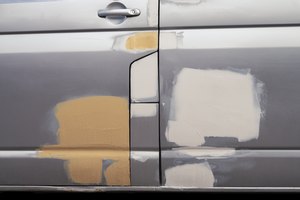
"Hi, I'm Joel Jones. I own Jonesey's, Inc., a company that specializes in auto restoration and customization. After you're finished color sanding, you're ready to move on to the polishing and buffing portion. The tools that you're going to need to do this are, you're going to need a variable speed rotary buffer, a dual-action buffer, which is also variable speed, but it doesn't have to be. You going to need a fairly aggressive wool bonnet, an aggressive rubbing compound, a less aggressive foam pad with a swirl remover, and then finally you're going to need a very soft foam pad and a final glaze. To wipe off all the compounds, you're also going to want an extremely soft, clean rag. So this panel here has been color sanded and wet sanded with two thousand grit, and now we're ready to utilize the rotary buffer with the wool bonnet on it, and a very aggressive rubbing compound. A couple things that I want to tell you guys is, you have to, when you're buffing, you want to use a slow a speed as possible, and you really want to be careful about all the edges of the panels. And what I mean by careful is, is that when you're buffing up close to the panel, the buffer rotates in this direction. And so when you get close to this, you want to go off the panel, and not onto the panel. And so the buffer need to run off of this edge, and not on to it. If you run it directly against that corner, you're going to burn through the paint, and that's going...you're going to have to repaint this panel. The same holds true with this. So, the recommendation that I have for anybody that has never done this before, is that you put a piece of masking tape right along that edge and right along the seam to protect those high spots until you get comfortable with the buffer. You're eventually going to have to buff those areas underneath the masking tape, but it will prevent you from getting too aggressive on the corners and the edges. So now, you're going to take the polishing compound, and squeeze it out pretty generously on the actual wool bonnet, and then roll the pad and spread it apart all across the panel that you're going to be...that you're going to be polishing. This causes the polishing compound to saturate the pad itself, as well as get distributed evenly over the panel. If you don't do that, as soon as you hit the trigger on this, then ninety percent of your polishing compound is going to go flying away. So, you want to use very, very light pressure with the buffer. You want the polishing compound to do the work, and not you forcing it in there. You want to keep it very comfortable, a good firm grip on the polisher, so that if it hits an edge, you're not going to ram yourself into anything. And then you want to work this until it becomes almost hazy and almost transparent. Right now it's totally white. And so you're going to work the polishing compound evenly all across the panel until it is almost clear. You can see how now it's kind of just a hazy film. There's still polishing compound on the surface, and we need to remove that before we move to the next stage. If you don't remove that, then the grit that's left behind is just going to get ground into the paint, and you're be going backwards instead of going forward. So you want to wipe with your soft cloth in one direction over the panel, so that you don't smear the compound back and forth. So, a one-direction wipe is what you wanna...how you want to remove this panel. And this holds true for all three of the compounds that we're going to be using. And now we're going to go one step finer with the swirl remover. The wool compound...the wool bonnet and the compound leaves very, very fine swirl marks from this rotary buffer, and we need to take those out using a finer compound and a finer pad as well. The same principles apply. You want to saturate your foam pad, spread it evenly across the panel, and then always be careful of your edges. So we finished up with the swirl remover, and you're going to wipe it off in exactly the same fashion as you did the compound. Just make sure you always have a clean section and you're not reintroducing the compound or the swirl remover back on to your panel. And now we're going to switch over to a dual-action polisher. And from a hobbyists standpoint, this is going to be the tool that you are going to use the most in maintaining your fresh paint. It is very user friendly, it doesn't rotate aggressively this way. It kind of gyrates around, just like your normal hand would. And so, you don't have to worry about the high edges as much, or the corners as much. We're going to use a final glaze, and this is the very last step in actual polishes. One thing that you need to keep in mind when you're doing this is that paint will continue to cure and out-gas for up to six months after you get it back from the paint shop. So you don't want to put any wax on a base-coat, clear-coat system, or even a lacquer paint job for six months, because it's still curing, it's still out-gassing and if you put something on there that stops that, then you can actually cause damage to your paint. People would disagree with this, but it's just a good idea to not protect your paint with anything until it's had time to harden. So we just got done using the random orbital or D-A buffer, and with our final glaze, and now doing the final wipe-down on our panel. And again, you always want to wipe things down in the exact same fashion, so you're not smearing any product that's left over onto the paint. We're getting down here where our run used to be, and you can see that there's absolutely no sign of it whatsoever. Any kind of light that you go in, you're not going to be able to see it. And that's because we took our time, using the block, using the sanding, and we didn't try to rush through it. Now, the panel that we just got done polishing looks like a piece of glass at this point. You want to take every single step, and do the whole vehicle on every single step. We just did one section from start to finish. So, this is going to take you about an entire day to do a whole entire vehicle. So, take your time, and do one section at at time so that you do it right, and then move on."

eHow Article: Hot Rod Restoration: Polishing the Paint

Related Ads

  • Have you done this? Click here to let us know.
Get Free Cars Newsletters

Copyright © 1999-2009 eHow, Inc. Use of this web site constitutes acceptance of the eHow Terms of Use and Privacy Policy.   en-US Portions of this page are modifications based on work created and shared by Google and used according to terms described in the Creative Commons 3.0 Attribution License.

eHow Cars
eHow_eHow Cars