
A Short Summary on Football
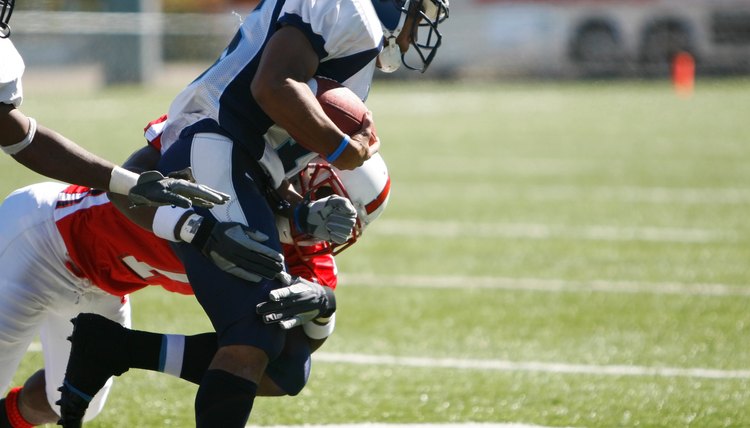
While football traces its origins to rugby and soccer, the unique history of American football has resulted in a game that substantially differs from its predecessors. As such, even those who are familiar with rugby and soccer might find football difficult to follow. Although a short summary might not sufficiently cover the intricacies of football, knowing its basic rules and goals can help you to develop a deeper understanding of the game.
The Field
Measuring 100 yards long by 53 yards wide, the boundaries of a professional football field are indicated by white lines at the edges. A white line is drawn across the field at each 5-yard mark, with small white lines drawn along each side of the field at every 1-yard mark between these. At each end of the field is an end zone, a 10-by-53-yard scoring area. The goalposts, or "uprights," are placed in the middle of the outer boundary of each end zone, measuring 10 feet high at the lowest point and 18 feet 6 inches wide, with 30-foot-high upright posts on each side.
Teams and Offense
Each team fields 11 players at a time, with the offensive team attempting to advance the ball down the field and the defensive team trying to prevent this. The offensive side revolves around the center, who snaps the ball back to start play, and the quarterback, who receives this snap and either runs, hands the ball to another player or passes the ball down the field. The remaining players are two offensive guards and two tackles, who defend the quarterback from the defensive line, and a varying number of wide receivers, who attempt to catch passes; running backs, who take the ball from the quarterback and run; and tight ends, who can both block the defense and catch passes.
Defense
The defensive side is composed of different numbers of linebackers, defensive ends and defensive tackles, all attempting to block runs and passes or break through the offensive line to tackle, or "sack," the quarterback before he releases the ball. The remaining players are cornerbacks and safeties, who follow offensive players down the field to prevent runs, block or intercept passes and try to force runners to "fumble," or lose possession of the ball.
General Rules of Play
The game is divided into four quarters, each measuring 15 minutes in length. Each half of the game begins with a kickoff, with one team kicking the ball up the field from its own 30-yard line and the other attempting to catch and run with the ball as far as possible. If the kick receiver is tackled or goes out of bounds, a first down is called. The offensive team must then advance the ball 10 yards for a new first down. If it cannot do this by the fourth down, possession automatically goes to the defensive team. Typically, however, the offensive team will "punt," or kick the ball up the field after the third down.
Scoring
If the offensive team is able to either run or pass the ball into the other team's end zone, it is credited with a touchdown and awarded 6 points. This is followed by an extra point attempt from the defending team's 2-yard line, with a kick through the uprights adding 1 point and a run or pass into the end zone adding 2 points. Also worth 2 points is a "safety," which occurs if the player with possession of the ball is tackled in his own end zone. If the offensive team wishes to add points without reaching the opposing team's end zone, its "special teams" may be called in to attempt a field goal. A field goal attempt is aimed at kicking the ball through the opposing team's uprights from a distance. If successful, it is worth 3 points.
References
Writer Bio
Matthew Lee has been writing professionally since 2007. Past and current research projects have explored the effect of a diagnosis of breast cancer on lifestyle and mental health and adherence to lifestyle-based (i.e. nutrition and exercise) and drug therapy treatment programs. He holds a Master of Arts in psychology from Carleton University and is working toward his doctorate in health psychology.