
What Are the Types of Passes in Volleyball?
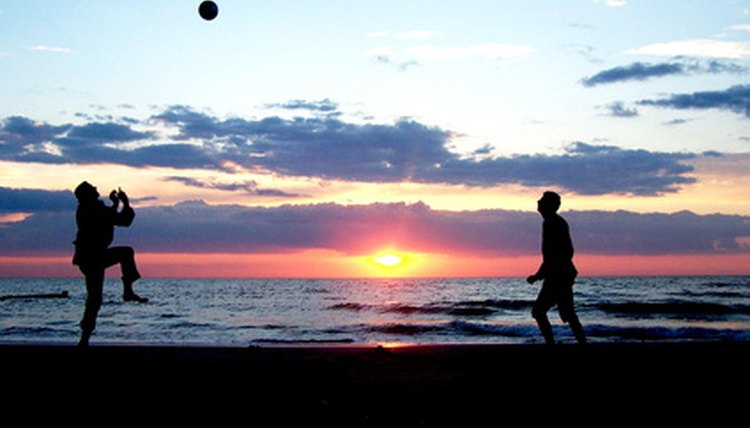
There are three main types of passes in the game of volleyball: bump, set and spike. Each team is allowed a maximum of three hits before they have to send the ball back over the net. A team will typically try to fulfill the passing strategy of bump-set-spike, although a block is an additional move in volleyball also used alongside the others as a defensive mechanism.
Bump
The bump is the basic pass in volleyball. It is used when receiving a serve or reacting to an opponent’s attack. The player should be holding his arms away from the body at a 90-degree angle with his hands together. Knees should be bent. The ball comes in contact with the lower forearms just above the wrist. After contact, the arms should point toward the target. Over-swinging the arms is a common mistake when perfecting the bump, as is contacting the ball with the wrists or hands. The first bump of a volley should be aimed at a setter so he can "set" up the volleyball for the spike.
Set
A set is typically a front-line pass, or a move done by players who are positioned near the net. Knees should be bent and hands extended 4 to 6 inches above the head. The fingers should be spread to imitate the shape of the ball; make a triangle with the thumbs and first fingers. The ball will make contact with the fingers right above the hairline. Then the arms are extended in the direction the player wishes the ball to go. Freeze the motion when the arms are fully extended. This pass must be done with coordination to avoid “holding” the ball. The ball cannot come to rest at any point during a volley.
Spike
The spike is an intense move in volleyball involving a player who is near the net. The purpose is to send the ball over the net and toward the floor so the opposing team has no time to save it before it touches the ground. The player should approach with two preparatory steps before a jump. The jump is straight up; the elbow should be raised level with the shoulder. The forearm should be up with the hand near the head in an open and relaxed position. Contact with the volleyball is made with the palm of the hand. The elbow should swing forward and the player should apply force. Follow-through with the motion is critical to strength and speed. It is illegal to hit the ball with a closed fist, and players should avoid a "shot-put" or "tennis serve" action, according to Volleyball World Wide.
Block
A block is a defensive move used when the other team attempts to spike the ball. The player must be right next to the net and jump at the same time—or moments after—the opposing player, to successfully block a spike. Hands are used to extend the height of the net, and fingers should be in a spread about the width of the ball. Arms are locked and when possible, players should try to reach slightly over the net with their hands to send the ball back on the opponents’ side. Touching the net is illegal and will end the volley. When blocking, it is essential that the body be square with the net; players positioned along the net often stand with their hands up and ready to block an attack.
Writer Bio
Michaelyn Erickson has been writing since 2005 and has been published regularly in a variety of northwest publications. She has written a science fiction novel and is now working on a children's book series. Michaelyn attends Evergreen State College where she is pursuing a degree in sustainable living.