There are many projects that you can investigate within a short period of time. Some science fair projects only take an afternoon to complete. Make sure that whatever project you choose is appropriate for the grade level. Relative sweetness of sweeteners might be a little simple for high school, and constructing and testing a hydrogen fuel cell might be too involved for elementary school.
Egg Drop
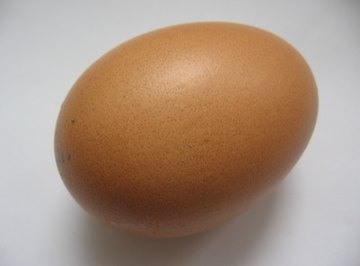
The egg drop experiment is a classic engineering investigation: Design a way to drop an egg from a roof without breaking it. Test your design, make modifications, and present the best design you found to protect the egg as it falls.
Magnets
Test the relative strength of a magnet by placing it in a dish with a lot of straight pins. Count and record the number of straight pins. Place the magnet in a dish of ice water and let it sit for several minutes to change temperatures. Record the temperature and do the same experiment with the straight pins. You can also do this with boiling water and different types of magnets, or different sized magnets.
Coin Cleaning
Test different solutions to find out which clean coins the best or the fastest. You can also test the pH of a solution to see if that plays a factor in how well or how quickly it cleans coins.
Baking
Experiment with different amounts of an ingredient in cookies to see how it changes the cookies' taste or the texture. You can try similar experiments with biscuits, pancakes, muffins or bread too.
Batteries
Build a battery out of a stack of pennies and nickels. Test the voltage and amperage it carries with a multimeter and adjust the number of pennies and nickels in the stack to see if that changes.
Kite Structure
Different types of kites have different structures. Examine which structures get airborne easiest or which fly the highest with less work from the kite flier. Is tail length a factor? Does running help? Does having an assistant help?
Hydrogen Fuel Cell
Using a homemade hydrogen fuel cell, how much electricity can you produce? Look at how the amount of power fluctuates between the beginning of the experiment and the end. Compare its efficiency to a battery or another type of fuel cell.
Sugars
Gather a collection of sugars and other sweeteners and look at their molecular structure. Have a large pool of people rate the relative sweetness of the sweeteners to see which is the sweetest. Make sure you use the same amount of each sweetener throughout the experiment, measured either by volume or by mass.
References
About the Author
Marissa Robert graduated from Brigham Young University with a degree in English language and literature. She has extensive experience writing marketing campaigns and business handbooks and manuals, as well as doing freelance writing, proofreading and editing. While living in France she translated manuscripts into English. She has published articles on various websites and also periodically maintains two blogs.
Photo Credits
Egg image by Andrei Leczfalvi from Fotolia.com