


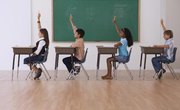
Students in classes that operate on a team basis learn more and perform better. Beyond academic achievement, race relations, social skills, class climate, self-esteem and higher-level thinking, all improve dramatically in classes that utilize cooperative learning, according to Dr. Spencer Kagan, the founder of Kagan Cooperative Learning. Regular inclusion of team-building games in the classroom creates an environment where cooperative, collaborative learning can take place.
Formations
Team-building games can function on many levels. When energy levels are waning, a game that involves physical action as well as group cooperation can help the students regain their focus and enthusiasm. The “Formations” game is from the Kagan book, “Cooperative Learning Structures for Teambuilding.” The teacher divides the class into groups of between five and eight. The teacher announces a “Formation,” such as a number, letter or polygon shape. The teams must discuss how they are going to make the formation using only their bodies, remembering that everyone must be involved. Each group attempts to be the first to successfully form the shape.
It’s a Small World
Appreciating what we have in common with others as well as what makes us unique is an excellent strategy for team building. This game, from the book “Joyful Living: Active and Collaborative Learning in Inclusive Classrooms,” is useful in new classes, classes with a number of new students and classes where groups are polarized. Each student needs a writing instrument and a piece of paper. The students partner up and each group writes a list of five things they have in common, such as number of siblings, color of the clothes they are wearing, favorite snack food and so on. After they have created the list of five things, the partners split up and wander around looking for someone else who has at least one list item that is the same. They create a new list with that person. The game continues for several rounds as time allows.
Blind Sequencing
When students have to work their way through a problem together, team building occurs. “Blind Sequencing,” another Kagan Structure from “Classbuilding: Cooperative Learning Activities,” encourages teams to communicate and problem-solve to reach a successful conclusion. The teacher creates sets of cards for each team that show a sequence. These could be the months of the year, words in alphabetical order, the story of Hansel and Gretel, or a sequence of numbers. There should be 1 to 3 cards per student. Each student should only look at his own cards. The students should mark the cards with their initials to avoid confusion later in the game. The teams must put the cards in sequence without looking at each other’s cards. The students can describe the cards to one another in any way they choose. When the team decides where a card can go in the sequence, the card is placed on the table face down. Team members may look at the cards with their initials that are on the table if the team is stuck. When the team believes the cards are properly sequenced, they can turn over the cards to check.
Related Articles






References
- "Joyful Learning: Active and Collaborative Learning in Inclusive Classrooms;" Alice Udvari-Solner & Paula M. Kluth; 2007
- "Cooperative Learning Structures for Teambuilding;" Spencer Kagan; 1997
- "Classbuilding: Cooperative Learning Activities;" Spencer Kagan; 1994
Writer Bio
A writer from Chicago, K.C. Winslow has been publishing articles relating to health, beauty, travel, crafts, education, Macintosh computers and technology since 2000. She holds a Master of Arts degree in writing from the University of Melbourne, Australia, where she lived for several years.