Basic Multiplication Facts Games

Basic Multiplication Facts Games thumbnail
Basic Multiplication Facts Games

For many kids, learning multiplication facts is a frustrating but necessary task. Multiplication games allow students to practice their multiplication tables while at the same time getting to play a game. The gaming aspect makes studying multiplication less tedious and more enjoyable.

  1. Houses

    • Houses is a multiplication game for two people which can be played with one, two or several multiplication tables at once. To begin with, draw a rectangular box on a whiteboard with a little decorative roof. Write the name of the times table you are using on the roof. For example, you could write "8s" or "8x." Make a grid of 3 rows of 4 multiplication problems in order. The leftmost one is 8 x 1, the next is 8 x 2 and so on, up to 8 x 12. The object of the game is to get as many combinations of 3 in a row as possible.

      To begin the game, the first player picks one of the problems and solves it. The next solves one in a different color marker. When the game is over, both players tally all the sets of three in a row they have. Any three problems in a row count, so if player 1 solve the first four problems, he gets two points--one for problems 1 through 3 and another one for problems 2 through 4. For a more involved game, put two or three houses side by side, each representing a different multiplication table.

    Dice

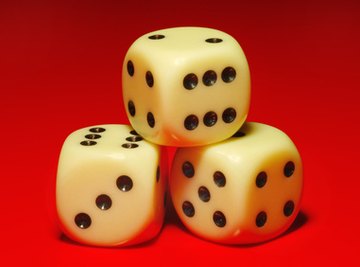
    • There are many different dice games that use multiplication facts. One simple one uses two 10-sided dice. Players take turns rolling both dice and multiplying the results. They then add the result to their previous total. Players can play until one player gets 500 points, or decide to stop the game after 8 rounds. For a simpler variation, roll one die at a time and multiply it by whatever multiplication family you are studying. For example, if you are studying fives and you roll a six, you would multiply 6 x 5 to get 30 points.

    Board Games

    • Many board games can be turned into multiplication games by substituting the six-sided dice with one or two 10-sided dice and throwing in a multiplication problem every turn. For example, to play multiplication Monopoly, exchange the two sixes for 10s. Each turn, the player rolls the dice and multiplies each by a particular table before moving. For example, if you were playing 7s Monopoly and rolled a three and a six, you would have to say, "Three times seven equals 21 and six times seven equals 42" before moving nine spaces.

Related Searches:
  • Photo Credit Hemera Technologies/AbleStock.com/Getty Images

Comments

You May Also Like

  • Basic Rules & Information on Badminton

    Basic Rules & Information on Badminton. Badminton has a rich history and remains a popular game that can be played with friends...

  • Multiplication Games for Upper Elementary

    For some students, simply memorizing multiplication facts is not enough. Many students learn multiplication through hands-on activities and games. There are a...

  • Multiplication Facts Games

    No matter how many computers and calculators are available, memorizing the multiplication table is a useful skill to have. Using games and...

  • How to Learn Multiplication Online

    Multiplication is a valuable and necessary skill taught to elementary school students in the second or third grade. Students continue to use...

  • Multiplication Learning Tools

    Multiplication Learning Tools. Learning multiplication can be difficult for many grade-school children. To simplify the learning experience, teachers and parents can ...

  • Multiplication Games for Students

    Multiplication is an important skill for kids to learn. vacation study 2 image by Paul Moore from Fotolia.com

  • 2-Digit Multiplication Math Games

    Math skills improve with practice. Unfortunately, most kids don't enjoy doing worksheet after worksheet of math problems. That's where games can play...

  • Basic Facts About Interactive Games

    Video games have come along way since the virtual table tennis game Pong became the first coin-op arcade game. Now games are...

  • How to Teach Basic Facts Memory

    To become familiar with a subject, students must sometimes memorize basic facts. However, many students find memorization unpleasant, so teachers must work...

  • Dice Games to Teach Multiplication Facts

    Dice Games to Teach Multiplication Facts. Capturing and holding the attention of students can be challenging in any content area, and math...

  • How to Make Multiplication Homework Fun

    Starting in second or third grade, children are expected to learn their multiplication tables. Many teachers require students to practice at home....

  • Multiplication Table Games

    Kids solve multiplication table equations as quickly as possible when playing Buzzy's Times Table Challenge at kidsnumbers.com. Buzzy carries a box and...

  • How to Practice Basic Math Facts

    Most parents want their children to do well in school, which makes it important to help kids practice basic math facts. Children...

  • Multiplication Facts Games for Kids

    Multiplication Facts Games for Kids. Elementary school children need to learn multiplication facts. Memorization of facts can be a tedious task for...

  • How to Play the Dice Game Multiplication

    The dice game Multiplication is a great gambling game to play with a group of friends when they are looking for a...

  • Games for Kids With Ways to Learn Multiplication Facts

    Multiplication facts are the products of single-digit numbers, such as 6 x 8 = 48. These facts are usually learned through the...

  • Math Facts & Games for Multiplication

    The idea of practicing multiplication facts may send some students running for the school nurse. However, learning basic multiplication facts does not...

  • The Differences Between Fact & Opinion

    The line between fact and opinion can be somewhat confusing -- as sometimes the phrase, "That's just your opinion!" implies that the...

  • How to Make a Board Game Using 20 Sided Dice

    Board games have been found in civilizations throughout human history. Possibly the earliest known board game is Senet, which originated in Predynastic...

Related Ads

Featured