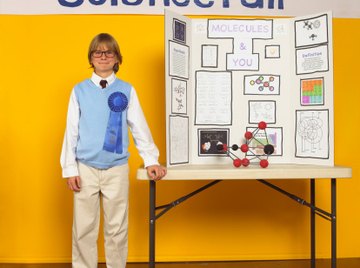

Helping your seventh-grader decide which science fair project to do is vital. You will need to determine what her particular scientific area of interest is and what kind of budget you are looking to spend on the project. Most children's science projects require little money, but you will need to make sure that the investment of time and effort is there. Your child has many different types of seventh-grade science experiments to choose from to bring to the school science fair.
Electric Produce
For this project, you will need an amp meter and an assortment of fruits and vegetables. The purpose of this experiment is to show which fruits and vegetables can generate an electrical charge. Take measurements of the produce by placing the probes close to each other and then far apart. Gauge the difference in electrical resistance and record your findings. The one with the highest ohms will be the one that generates the highest electrical charge.
Microorganisms and Temperature
You will need to acquire plastic soda bottles, sugar, yeast and medium-sized balloons. The focus of this experiment is how various temperatures affect microorganisms. Take the yeast and divide it into three separate samples, add water and allow five to 10 minutes for yeast to react. Take two of the samples and place in the freezer. Remove one once frozen and leave the other in refrigerator for up 20 to 24 hours. Take all three samples and place them in hot water for 5 to 10 minutes. Add sugar to the sample not placed in the refrigerator. Then do the same for the other two samples. Now observe the amount of gas the samples release. Record your findings.
Meteors and Craters
You will need plastic as well as glass marbles, golf ball, small pebbles, flour, tape measure, cocoa powder and an aluminum baking pan. This experiment focuses on measuring meteor and crater size. First, pour the flour and cocoa powder into the pan. Drop the golf ball into the pan and measure the the width and depth of the crater. Record your findings. Repeat this process for the marbles as well as the pebbles. Now measure the width of all "meteor" objects and compare them with the crater width they created on impact. Determine which "meteors" weigh more than others and come up with a hypothesis on how the sizes and weights of meteors affect the sizes and depths of the craters they create.
Dehydration
The purpose of this experiment is to measure how a higher moisture content causes a faster rate of dehydration. You will need an apple, orange, peach, tomato and a small scale. Cut each in half, place them on a plate and leave them in the open air to dry. Examine each piece every two days, measuring and weighing them. Record your findings. You will find that the pieces that started out with a higher concentration of moisture dehydrate at a faster rate. Create a graph chart to further demonstrate your research findings.
References
About the Author
Mark Bouton has been writing professionally since 2010. He is a contributing writer for various websites, specializing in history, science, theology and art. He has a Bachelor of Science in theology from Philadelphia Biblical University.
Photo Credits
Brand X Pictures/Brand X Pictures/Getty Images