India's Monuments

India's Monuments thumbnail
India is home to some beautiful monuments.

India is a nation rich in history, which dates back almost 5,000 years when India's first civilization arose along the banks of the Indus River. The Indus Civilization existed at the same time as the Egyptians and Sumerians, but far outlasted them. Throughout the centuries since the collapse of the Indus Civilization in 1700 B.C., there have been many changes in leadership on the Indian subcontinent. Along the way, many beautiful monuments have been created by the diverse peoples of India.

  1. Taj Mahal

    • Taj Mahal
      Taj Mahal

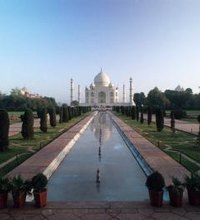
      In the large city of Agra, with a population of around 1.5 million, is the Taj Mahal. A long labor of love undertaken by Shahjahan as a memorial to his wife, Mumtaz Mahal, who died in childbirth at the age of 39, the Taj Mahal is actually a beautiful mausoleum. Watercourses within the complex divide the gardens into quadrants, which is symbolic in three ways: as a symbol of paradise, an oasis from the desert heat, and a summation of the royal pleasure garden. Symbolically, the watercourse is representative of the life source and the meeting of man and God. The Taj Mahal is easily reached via express bus service from Delhi, Jaipur, Lucknow, Gwalior and Jhansi. It is also easily reachable via air travel from Delhi's Indira Gandhi Airport.

      Taj Mahal
      Purani Mandi
      Agra, Uttar Pradesh, India

    Qutub Minar

    • Qutub Minar
      Qutub Minar

      Located in Delhi, construction on the world famous Qutub Minar was started in 1192 by Qutub-ud-din Aibak, the first Sultan of Delhi and founder of the Slave Dynasty. There are many theories, among those living within Delhi, as to the origin of this tower. Some believe it to have been an ancient observatory, while others believe it to have been built by Prithvi Chauhan, a king from the Hindu Kshatirya Chauhan dynasty, for his daughter. However, the tower's design and architecture are distinctly Islamic in nature, and so the other theories are just the imagination of those living within Delhi. It has been suggested that Qutub-ud-din-Aibak lived only long enough to see the first story completed and that Altamash, his successor, actually completed the tower, which today is the world's tallest freestanding minaret at 234 feet.

      Qutub Minar
      Mehrauli
      New Delhi, India

    The Red Fort

    • Red Fort
      Red Fort

      Situated in Delhi, the Red Fort was built during the reign of Shah Jahan and was completed in nine years at the cost of approximately 10 million rupees, or roughly $218,000 USD. Like most Islamic buildings in India, the Red Fort is octagonal in shape, and it is connected on the north side to the smaller Salimgarh Fort. Red Fort measures approximately 2,953 feet by 1,804 feet, and rises to a height of 109.9 feet. Outside of the fort, the original moat, which was at one time connected to the Yamuna River, can be seen. There are two entry points to the fort, Lahori Gate and Hathipol or elephant gate, where the king and his visitors would dismount from the elephants. Each year, to celebrate India's independence from Great Britain, the Prime Minister raises the National Flag of India at the Red Fort on Aug. 15th.

      Red Fort
      Mahatma Gandhi Marg
      New Delhi, India

    Jag Niwas (Lake Palace)

    • Lake Palace
      Lake Palace

      Jag Niwas served as the pleasure palace of the Sisodia rulers for more than a century. Prior to 1734, the palace pavilions were constructed. After his coronation in 1734, Gadi Rana Jagat Singh II expanded the water palace and named it after himself. Built in a perfect circle, the upper room of the palace is about 21 feet in diameter, with floors inlaid with black and white marble. The walls are decorated with arabesques of colored stones in the same style as the Taj Mahal. Other notable objects of interest are Shah Jahan's throne, which was sculptured from a single block of serpentine and a room built with 12 hue slabs of marble. Bhagwat Singh, who ascended the throne in 1955, began preparing himself for the future of his dynasty and converted the palace to a hotel that today is run by the Taj Group of Hotels, which has turned the water palace into one of the more popular Indian tourist sites.

      Post Box Number 5
      Lake Pichola, Udaipur 313 001

Related Searches:

References

Resources

  • Photo Credit india image by creative from Fotolia.com taj mahal image by Sean Wallace-Jones from Fotolia.com qutb minar image by ralf werner froelich from Fotolia.com krakow castle image by aldaer from Fotolia.com sacred lake image by mansa from Fotolia.com

Comments

You May Also Like

  • National Monuments in India

    National Monuments in India. The land of India is one of the most ancient places of world civilization. It has monuments, temples...

  • Monuments of India's Medieval Period

    Monuments of India's Medieval Period. India's Medieval period is generally known as the Mughal Empire, a period that lasted from 1525 to...

  • Major Monuments of India

    Major Monuments of India. India is one of the world's oldest civilizations and is also home to a variety of religious faiths,...

  • Ways to Protect Indian Monuments

    Ways to Protect Indian Monuments. Monuments are important in societies because of their historical, political, memorial, cultural or symbolic significance, and the...

  • Historical Monuments in India

    The Taj Mahal is India's most famous monument. taj mahal image by Sean Wallace-Jones from Fotolia.com

  • Monuments in Ancient India

    Monuments often house sacred practices inside their beautiful exterior. When thinking of India's most famous monuments, the immediate front-runner is most likely...

  • Important Monuments in India

    Important Monuments in India. India is a land of mystery and beauty, with centuries of historical landmarks representing its colorful history and...

  • Monuments of Calicut, India

    Monuments of Calicut, India. Calicut, also known as Kozhikode, is a city in the southern Indian state of Kerala. During the Middle...

  • Facts About the Taj Mahal in India

    The Taj Mahal, located in Agra, India, is one of the architectural wonders of the world. Commissioned by the emperor Shah Jahan...

  • How to Make Birdfeeders Using Elephant Ears

    There's no need to buy a generic bird feeder from a store when you can create one that doubles as a unique...

  • British Monuments in India

    British Monuments in India. British influence in India began in the 17th century with the arrival of the British East India Co....

  • Historical & Cultural Monuments

    Historical & Cultural Monuments. Historical and cultural monuments are scattered across the United States to memorialize various events in the country's history...

  • Historical Monuments in Delhi

    Historical Monuments in Delhi. Delhi is the gateway to India for most overseas visitors and has been a crossroads of history in...

  • Costumes of Ancient Indian Civilization

    Clothing in ancient India was often made of a large unsewn length of cotton or other material that was wrapped around the...

  • Regional Engineering Colleges in India

    Regional Engineering Colleges in India. India established most regional engineering colleges in the 1960s. The Andra Pradesh Institute, established in 1959, is...

  • Indian Monuments

    With a cultural heritage stretching back many thousands of years, India is the site of some of the world's most significant monuments,...

  • Types of Ancient Indian Artifacts

    Civilization in India began about 5,000 years ago in the Indus Valley, along the banks of the Indus River. Artifacts found in...

  • List of Monuments

    List of Monuments. Monuments to humans and their accomplishments have been around for millennia. Markers of wars and peace, gods and animals...

  • Historical Monuments of Uttar Pradesh

    Historical Monuments of Uttar Pradesh. The state of Uttar Pradesh, located in northern India, is the world's most populated sub-national entity. Known...

Related Ads

Featured