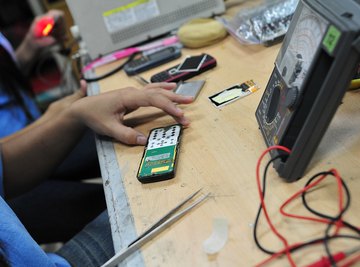

High school level engineering science projects usually focus on mechanical engineering and electrical engineering. Mechanical engineering projects usually emphasize the use of mechanical power to perform work on other objects, and electrical engineering includes circuits, alternative sources of energy, and the generation of energy in general. You can choose from a variety of engineering science projects based on your interests, time constraints and materials available.
Solar Energy
You can use a science project to explore solar energy, the simplest method to convert renewable energy into a usable source. Projects that demonstrate the use of solar energy include solar air heaters, solar water heaters, and solar ovens. In short, you'll be collecting solar energy by painting part of your project black, which attracts the sunlight. You can then use different methods to funnel the attracted heat energy into air, water or food. To add and element of inquiry, design an experiment based on a question about how these sources work, such as "How is the temperature outside related to the temperature within a solar air heater?" or "How is the amount of water in the tank related to the speed at which the solar water heater can heat it up?"
Rube Goldberg Machines
A hands-on way to learn about mechanical engineering is by building a "Rube Goldberg" machine, named after a famous cartoonist who designed complicated machines to complete ordinary tasks. You can include levers, pulleys, fans, rolling balls and gears to create a machine that does anything from pour a cup of juice to press the "on" button on a laptop. Make it as crazy and complex as possible, but more importantly, make sure that the machine works consistently and accurately every time. Note that some science fairs do not allow Rube Goldberg machines because they do not demonstrate knowledge of the scientific method.
Marble Run
Building a marble run helps you review the concepts of potential and kinetic energy. You can use foam pipe insulation as the marble run's track, which will allow you to create vertical loops. To design the experiment, hypothesize how high off the ground the start of the track would need to be in order to give the marble enough energy to complete a low loop of a given height. Then test your hypothesis by creating a track with the start at that height and see whether the marble can complete the loop. If so, determine whether it can still complete the loop at a lower height; if not, determine how high the start of the track has to be in order for the marble to have enough potential energy to make it through the loop successfully.
Building Batteries
Homemade batteries are usually not strong enough to do any major mechanical work, but they can move the needle on a voltmeter. In order to create your own battery, dip several small squares of paper towel in lemon juice and make a stack of items in the following order: penny, lemon-soaked towel, nickel, lemon-soaked towel, penny, lemon-soaked towel, nickel. You can then put the two probes from the voltmeter on either end of your coin-battery and register how many volts of electricity the battery has produced. Research and design an experiment to determine how the battery works -- swap lemon juice for other liquids that you think will work, or swap the coins for other materials, and see which ones act as true batteries based on voltmeter readings.
References
About the Author
Keren (Carrie) Perles is a freelance writer with professional experience in publishing since 2004. Perles has written, edited and developed curriculum for educational publishers. She writes online articles about various topics, mostly about education or parenting, and has been a mother, teacher and tutor for various ages. Perles holds a Bachelor of Arts in English communications from the University of Maryland, Baltimore County.
Photo Credits
Veejay Villafranca/Getty Images News/Getty Images