
Salt can have a negative effect, a positive effect or no effect on yeast. Salt draws water from everything around it and the effect of salt on yeast depends of the ability of a particular species to cope with salt trying to draw essential water away from the yeast cell, also known as osmotic stress.
While Making Bread Dough
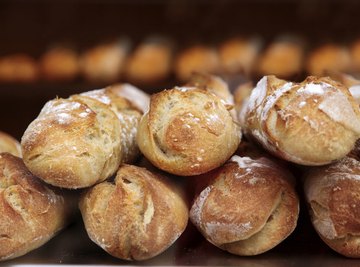
Although salt can give dough added seasoning, too much salt can have a negative effect on baker's yeast. The cell wall of bread-making yeast is semi-permeable; when a significant amount of salt is nearby, a yeast cell will release water. Because this water is necessary for its cellular activities, releasing it will slow down the reproduction and fermentation activities of the yeast. Knowing this, bread and pizza makers will base the amount of salt in their dough partially on how active they want their yeast to be.
On the Fermentation Process
According to a 2010 report in the International Journal of Wine Research, salt boosts the activity of the wine-making yeast Saccharomyces cerevisiae. The European study team found that exposing yeast to a high-salt solution increased the fermentation activity of the yeast. They speculated that exposure to the high-salt solution caused the yeast to produce protective metabolites. These metabolites could have guarded the yeast against osmotic stress and the toxicity of ethanol produced during the fermentation process.
Effect on a Yeast Infection
Although it has not been shown to be an effective cure, a salt bath is often recommended as a home remedy to treat symptoms of a common yeast infection caused by Candida albicans. However, a similar strain of yeast, Candida dubliniensis, is much more susceptible to the osmotic forces created by salt. According to a 2010 report by researchers at Trinity College in Dublin, Ireland -- a C. albicans gene called ENA21, which is known play a role in pumping sodium out of C. albicans, seems to make it more pathogenic than C. dubliniensis.
Yeast Adapting to Salt Concentrations
In 2011, researchers at McGill University revealed that baker's yeast is capable of adapting to high concentrations of salt via evolution. The researchers found that the degree and pace of change of the yeast's environment and the amount of previous exposure to a high-salt environment all played a role in determining whether the yeast would evolve. The team noted that "rescue by evolution" happened relatively fast during their trials, taking place within 50 to 100 generations.
References
About the Author
Brett Smith is a science journalist based in Buffalo, N.Y. A graduate of the State University of New York - Buffalo, he has more than seven years of experience working in a professional laboratory setting.
Photo Credits
cmfotoworks/iStock/Getty Images