Ultraviolet light, commonly known as UV light, is one type of electromagnetic radiation that comes from the sun and is transmitted at different wavelengths and frequencies. On the electromagnetic spectrum, UV light falls between visible light and X-rays and can be split into UVA or near UV, UVB or middle UV, and UVC or far UV. Ultraviolet light has many applications ranging from medical therapy to photography.
UV Light in Tanning
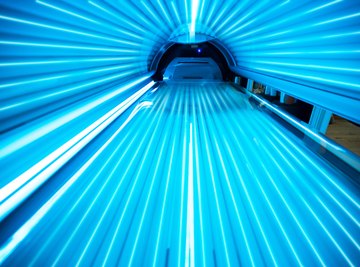
Sunburn is a familiar effect of overexposure to UV light. When your skin is exposed to UVB rays, the body's natural defense mechanism kicks in, producing a pigment called melanin, which absorbs UV light and spreads it as heat. Your skin goes darker because the body sends melanin into neighboring cells to try to prevent damage. Tanning booths use artificial UV light in lamps that pass electric currents through a gas, such as vaporized mercury.
UV Light in Lamps
Lots of natural and manufactured substances can absorb UV radiation, including plants, fungi and synthetic fluorophore. When the UV light is absorbed, the electrons in the material reach a higher energy level before going back to their lower level in a series of smaller steps. With each step, they release part of their absorbed energy as visible light. Fluorescent lamps ionize vapor in their tubes, making electrons in the gas give off photons at UV frequencies. A phosphor layer on the inner side of the tube changes the UV light into standard visible light.
UV Light in Chemistry
Scientists use UV light to analyze the chemical structure of a compound via color changes. A machine called a spectrophotometer, which is much more sensitive to color than the human eye, passes a beam of UV light through a solution and shows how much of the radiation is absorbed by the compound using color changes. This process is often used in chemical and biological plants, hospitals, water quality control laboratories, the petrochemical industry and the food industry. For example, it can screen unwanted compounds in water by monitoring the color of water during the production of drinking water.
UV in Light Cancer Treatment
While exposure to UV light is a known risk for skin cancer, some cancerous skin conditions can be treated using UV light. Patients receive drugs called psoralens, which react to UVA light treatment and slow the growth of cells of skin lymphoma as well as eczema, psoriasis and vitiligo. If a patient has thin skin lesions, UVB without additional drugs may be used instead. Although the treatments are given with lamps similar to false tanning lamps, the light boxes used for treatment are calibrated, so the precise wavelength and dose is received, minimizing the risk of burning the skin.
UV Light in Photography
UV photography, which is often used for medical, scientific and forensic purposes, uses specific lenses to let UV light pass through the camera's lenses. Nature photographers may use UV photography to capture patterns in flowers the human eye cannot see. By modifying their cameras, they can collect only the UV light that hits the camera sensor.
References
About the Author
Claire is a writer and editor with 18 years' experience. She writes about science and health for a range of digital publications, including Reader's Digest, HealthCentral, Vice and Zocdoc.