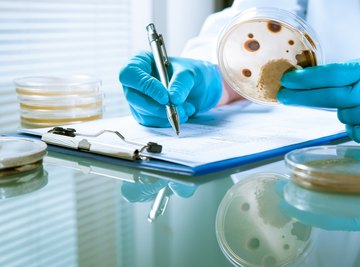

Agar is a gelatinous polymer substance derived from red algae and commonly used in a biological laboratory setting as a substrate. Agar plates are petri dishes containing agar in combination with a growth medium to culture microorganisms such as bacteria. After planting initial microorganisms on the gelatinous surface of the plate, researchers incubate them at body temperature to form colonies for isolation and analysis. Agar plates come with many different types of media or nutrients, depending on the microorganism you want to culture.
Blood Agar Plates
Blood agar plates (BAP) are made by adding five to ten percent sheep or horse blood to the nutrient medium. The red blood cells remain intact in the agar and make the plates a blood red color. It is an enriched, non-selective differential medium that supports growth of a variety of bacteria and can detect hemolytic activity of the microorganism. Bacteria can be beta-hemolytic and lyse the red blood cells in the agar, alpha-hemolytic and partially lyse the red blood cells, or gamma (non)-hemolytic and cause no change in the red blood cells. Chocolate agar plates (CHOC) do not actually contain chocolate, but are a type of blood agar plate in which the red blood cells have been lysed, making the agar plates dark brown in color. They detect organisms that are difficult to grow, such as Haemophilus influenzae and Neisseria gonorrhoeae.
Nutrient Agar Plates
Nutrient agar grows the largest variety of microbes, typically fungi and bacteria. It typically contains nutrients from either beef broth or yeast extract, depending on what you want to grow. There are a few types of general nutrient agar plates. Luria Bertani (LB) agar is a common nutrient agar for the general routine growth of bacteria and is not preferentially suited toward a particular microbe type. Miller’s LB agar is a variety of LB containing different proportions of the same components. Trypticase Soy agar (TSA) is another general purpose medium made with casein and soybean meal and is used as initial growth medium to observe bacterial morphology or increase bacterial growth for analysis or storage. Phenylethyl alcohol agar (PEA) is selective for species of Staphylococcus and inhibits Gram-negative bacteria.
MacConkey Agar Plates
MacConkey agar plates (MAC) are a differential type medium made with bile salts and crystal violet. These additives cause the agar to only allow growth of Gram-negative bacteria, while inhibiting the growth of Gram-positive organisms. This agar can also contain lactose to distinguish between lactose-fermenting and non-lactose fermenting bacteria by forming either red (lactose-fermenting) or clear colonies. Eosin Methylene Blue (EMB) agar plates do the same thing but use two dyes, eosin and methylene blue, to differentiate between the bacteria.
Other Kinds of Agar Plates
There are many other types of agar plates that can select for or differentiate between specific species of bacteria or other microorganism. Bile esculin agar plates (BEA) select for Entercocci and Group D Streptococci. Mannitol salt agar (MSA) selects for organisms that ferment mannitol by turning the plate yellow through a pH change. MSA also differentiates between the pathogenic and non pathogenic type of Staphylococci. Sabouraud dextrose agar (SDA) allows growth of fungi, yeasts and mold and has a low pH, preventing growth of bacteria.
References
About the Author
Sarah Quinlan has experience writing for various websites on science, biology, veterinary science, health and medicine. For over seven years she has worked as a scientist in various biological fields where she has written and contributed to multiple manuscripts that have been published in scientific journals. Quinlan holds a bachelor's degree in zoology and a master's degree in forensic biology/chemistry.