
Density Experiments for Kids

Density Experiments for Kids thumbnail
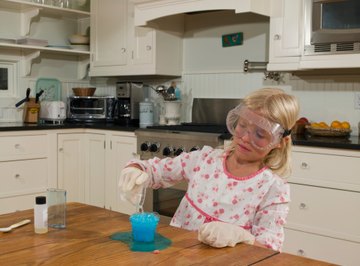
Kids perform density experiments at home or at school.

Density is an abstract concept for young students. Use creative experiments to demonstrate density visually at home or in the classroom. Use common items such as water, eggs, oil and salt to demonstrate density. Practice the experiments ahead of time to determine how much of the substances you will need and what results kids should expect.

  1. Seven Layers of Density

    • Let kids visualize the concept of density with this experiment. Collect substances of various densities, including honey, light corn syrup, dish soap, water, vegetable oil, rubbing alcohol and lamp oil. Have kids guess the order of densities of the substances. Mix different colors of food coloring with each of the substances to distinguish them. Pour 1/2 cup of each substance into a clear glass or graduated cylinder. Observe how the substances layer in the glass according to their densities. Have students look up the exact densities of the substances to check their results.

    Straw Colors

    • Place four cups on a table and add 1 cup of water to each one. Add 1 tsp. salt to one cup, 1 tbsp. salt to the second cup, 3 tbsp. salt to the third cup and 5 tbsp. salt to the fourth one. Stir each of the cups to make solutions of different densities. Drop a few drops of different colors of food coloring into each cup to help visualize the solutions. Close one end of a clear straw with a piece of sticky tack or clay. Drop several drops of each color of food coloring into the straw and watch the layers separate according to density.

    Egg Float

    • Students make an egg float and test the densities of different objects. Have them fill a clear glass 3/4 full with water. Ask them to put a quarter, a cork and an egg into the glass of water and observe whether the objects sink or float. Ask them to add salt to the glass 1 tsp. at a time, stirring the glass after each addition. Eventually the egg will float because of the increased density of the water due to the addition of salt. Ask students to record the number of teaspoons of salt that made the egg float.

    Hot and Cold

    • Discuss how temperature affects density with this experiment. Put cold water into one glass and hot water into a second glass. Ask students to put a few drops of food coloring into each glass and record their observations. The food coloring moves through the glass with hot water faster because hot water is less dense than cold water.

Related Searches:

References

  • Photo Credit D. Anschutz/Digital Vision/Getty Images

Comments

You May Also Like

  • Kids' Density Experiments With Salt, Water & Eggs

    The more molecular matter contained in an object, the higher its density and the more it weighs. Salt water is denser than...

  • Air Density Standard Conditions

    In order to obtain repeatable experimental results, a number of standard conditions regarding air density, such as those of the National Institute...

  • Density & Buoyancy Experiments

    Density & Buoyancy Experiments. Density and buoyancy are two physical characteristics of solid objects that are best taught through hands-on experiments. Buoyancy...

  • Free Food Coloring Experiments

    Simple experiments can demonstrate various aspects of science in ways both kids and adults can appreciate and understand. Using food coloring can...

  • Experiments with Mixing Oil & Water

    Oil and water are great common household items to use in density experiments. Since oil and water have different densities based on...

  • Science Projects on the Density of Water

    Density can be thought of as a measure of how much mass there is in an object or substance, such as water....

  • Density Experiments

    Density can be a difficult concept to explain and to understand. As with most any topic in science, the easiest way to...

  • Chemistry Density Experiments

    Density is the relationship between the mass and the volume of an object. For example, one cubic meter of cork is much...

  • How to Teach Kids About Density

    Kids learn by example, and teaching science concepts such as density can be accomplished with fun classroom activities. Everything is made up...

  • Water Density Science Experiments

    Density is measured as the ratio of a material's mass in comparison to its volume, and is an important property of materials....

  • Experiment on Measuring Density of Liquids

    An experiment measuring the density of liquids provides an opportunity to learn about density, mass and volume. Taking measurements and using a...

  • What Floats in Salt or Sugar Water?

    Corn oil is a solution that will float in normal water due to its lower density. Corn oil has a density of...

  • Grade Eight Density Experiments

    One way to explain density to students is through hands-on experiments. Physical properties like density are particularly good candidates for this strategy...

  • How to Demonstrate the Density of Liquids

    The density of liquids is a property matter that is learned throughout middle school and high school. Density is calculated by dividing...

  • Water Tension Experiments for Kids

    Water Tension Experiments for Kids. The surface tension of water is caused by water molecules expanding and bonding together. Water tension can...

  • Science Projects on Making Eggs Float

    The idea of the magic egg project is to see if an egg will float in a liquid that is more dense...

  • Egg Flotation Experiments

    Egg flotation experiments are an inexpensive and often effective way to teach students about density -- of both raw and boiled eggs...

  • Food Coloring & Science Projects

    Learning about science concepts with elementary students is exciting when it is accomplished through fun experiments. These science projects using food coloring...

  • What Is the Density of an Egg?

    Density is a physical property of a substance that can be determined by scientific experiment. You might have learned that density is...

  • How to Maintain Bone Density

    People normally begin to experience a decrease in bone density as early as age 20. Working to counter that natural decline and...

Related Ads

Featured