
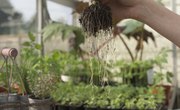
Although children may be too young to be familiar with the methods for experimentation, they are not too young to understand the meaning of the concepts. If you can explain and demonstrate the concepts underlying the scientific method in an age-appropriate way, kids can grasp how it works. With your help and a few basic rules in scientific experimentation, a child can run her own simple experiments.
What is a Variable?
A “variable” is a word for a quantity or condition that can change. Variables can be continuous or they can be discrete. Continuous variables can have many values. For example, time is continuous and can have many values. Plant growth, amount of sunlight or amount of water flowing are all continuous variables. Discrete variables are ones that have a few, distinct values. Something can be either on or off, present or absent, or have only several countable possibilities. A kitchen light can be on or off or a person may have blue, brown, green or hazel eyes.
Independent Variable
An independent variable is a variable that you can control. One way to explain it to a child is that it is the variable that the child can change during the experiment. For example, in an experiment on the effect of light on plant growth, the child can control how much light a plant receives. He can put one plant near a window and another plant in a dark closet.
Dependent Variable
A dependent variable is the variable that you observe and measure. You have no control over the dependent variable; you want to observe what happens to the dependent variable when you change the independent variable. For example, if the child is testing the effects of light on plant growth, how much the plant grows after some period of time would be the dependent variable. The child can measure how much the plant in the closet grows relative to how much the plant near the window grows.
Controlled Variables
Besides independent and dependent variables, every good experiment needs to control certain variables so that they do not influence the outcome of the experiment systematically. A controlled variable is one that you keep the same for all the conditions of your experiment. A good scientist needs to think through all the variables that might need to be controlled so that they do not interfere with the experiment. For example, to get reliable results for the plant experiment, both the plant near the window and the plant in the closet need to receive the same amount of water so that testers would know that it was the differences in light and not the differences in water that made one plant grow more than the other.
References
About the Author
Danielle Cort has been a freelance writer since 2008, specializing in psychology, health, education and parenting. She has published articles in "Family" magazine. Before becoming a freelance writer, Cort worked in the public policy research sector, conducting research, creating surveys and budgets. She holds a Doctor of Philosophy in social psychology from the University of Massachusetts.