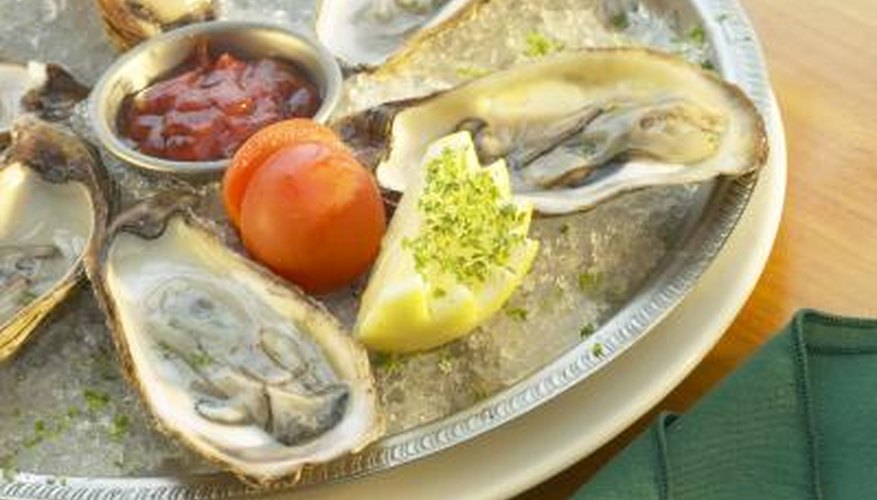

Seafood lovers in Texas have plenty of opportunities to fish or harvest oysters and clams. The bays and estuaries of the Lone Star State teem with shellfish that you can eat alive and raw. You can catch these delicacies in productive areas like bay systems with significant freshwater inflows. The primary type of oyster in the state is the Eastern oyster, a shellfish with two shells connected at one end by a hinge and retained by the adductor muscle.
Items you will need
Fishing license
Saltwater stamp endorsement
Sturdy gloves
Wading boots
Bucket
Clam shovel
Cool, damp cloth
Oysters
Step 1
Obtain a valid, state-issued fishing license and a saltwater stamp endorsement. This is required by Texas Parks and Wildlife for anyone wishing to take oysters in state waters.
Step 2
Search for oysters on intertidal beaches and in shallow waters. They are usually in groups connected to one another or near solid objects like shells and rocks. Oysters can be harvested only from waters approved by the Texas Department of State Health Services. Go to dshs.state.tx.us for harvesting area maps or call 800-685-0361 to check the status of shellfish harvesting areas.
Step 3
Wear sturdy gloves and wading boots. Wait for the water to recede and search in mud mounds for oysters. Pick and collect them by wading through the sand or mud to the oyster mounds and then pulling through the clumps. Put your catch in the bucket.
Step 4
Go through your catch and use a shellfish gauge to measure the oysters for legal size. As of July 2011, Texas Parks and Wildlife states that you can keep only oysters three inches or larger (as measured by the greatest length of the shell). Return all illegal-sized oysters.
Step 5
Follow catch limits. A maximum of two sacks of legal oysters can be taken in Texas state waters. Each sack cannot exceed 110 pounds.
Clams
Step 1
Obtain a fishing license and a fishing stamp endorsement.
Step 2
Search in the sand of intertidal coastal beaches. Look for a hole or dimple in the sand that indicates a spot where a clam has started to dig. Clams are also found at the edge of the surf line when you dig the beach with your foot or a shovel handle. Dig carefully through mixed sand, mud and gravel using the clam shovel. Dig holes 8 to 14 inches deep.
Step 3
Ensure your clam-digging area is state-approved. Just like oysters, clams taken from public beaches must be approved by the Texas Department of State Health Services.
Step 4
Place the clams in your catch bucket and cover with a cool, damp cloth.
Step 5
Follow catch limits. You can take a maximum of 25 pounds of whole clams or a maximum of 12 pounds of clam shells per day.
Warnings
- Consumption of clams taken from public fresh waters is prohibited by the Texas Department of State Health Services.
Tips
- Shells of live oysters and clams should be tightly closed or slightly open. If the shells are open, close them by tapping lightly with your finger. If the shell is wide open or does not close after tapping, the clam is dead and should be thrown away.
References
Tips
- Shells of live oysters and clams should be tightly closed or slightly open. If the shells are open, close them by tapping lightly with your finger. If the shell is wide open or does not close after tapping, the clam is dead and should be thrown away.
Warnings
- Consumption of clams taken from public fresh waters is prohibited by the Texas Department of State Health Services.
Writer Bio
Rona Aquino began writing professionally in 2008. As an avid marathon runner and outdoor enthusiast, she writes on topics of running, fitness and outdoor recreation for various publications. Aquino holds a Bachelor of Arts in communications and English from the University of Maryland College Park.