
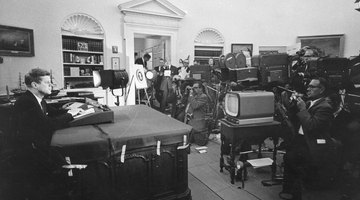


The Cold War was a nearly 50-year-long political, ideological, and military struggle for global power that was waged between the United States and the Soviet Union. From the end of World War II until the early 1990s, the Cold War was the United States' preeminent international concern, directing all of the nation's major foreign policy decisions.
Origins of the Cold War
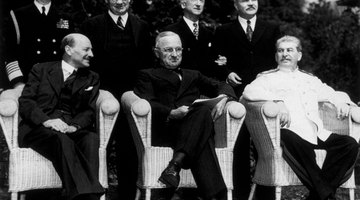
Immediately after the Soviet Union rose out of the ashes of the Russian Empire in 1917, tensions began as the U.S. feared the spread of communism, a governmental system antithetical to its capitalist ideology. Tensions temporarily eased when the nations became unlikely allies in World War II, but reemerged with a vengeance as the U.S. demonstrated its nuclear power and the Soviet Union swallowed up Eastern European nations into its "bloc." The former allies quickly became enemies again.
The Truman Doctrine, Marshall Plan, and Containment
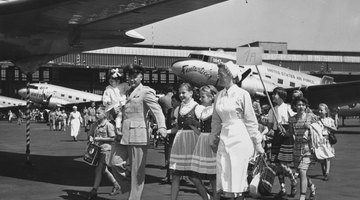
By 1947, the U.S. had developed a clear policy of containment toward the Soviet Union, striving to prevent the spread of communism through economic, diplomatic, and military measures. Through the Marshall Plan the U.S. used nearly $13 billion in aid to fight communism by helping war-torn Europe return to prosperity. Similarly, during the struggle over Germany's capital, Berlin, the U.S. airlifted over 2.5 million tons of supplies to West Berlin until the Soviet Union lifted its blockade. The U.S. also established NATO (the North Atlantic Treaty Organization), a diplomatic and military alliance with Western European nations. NATO members pledged mutual protection against the communist threat and military cooperation to contain communism. Additionally, the Truman Doctrine promised monetary and military aid to support any "free peoples" resisting "subjugation by armed minorities or outside pressures." The doctrine helped relieve conflict in Greece and Turkey (1947) and justified U.S. military intervention in Korea starting in 1951.
Containment and the Flexible Response
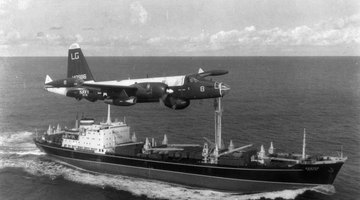
Succeeding Truman, President Eisenhower initially adopted a tough stance against the Soviet Union and dramatically increased the U.S.'s stockpile of nuclear weapons. The U.S. likely never intended to use these weapons. Rather, they served as a deterrent to future military conflict between the two superpowers -- both sides possessed them but their use would mean total destruction. The Kennedy and Johnson administrations advocated a "flexible response" to containing communism, supporting a failed attempt by Cuban exiles to overthrow Fidel Castro, issuing a naval blockade with the threat of nuclear weapons during the Cuban Missile Crisis and deploying troops to prevent the spread of communism in South Vietnam, a decade-long struggle that caused domestic turmoil in the U.S. Containment also took place in more subtle ways. True to the adage "The enemy of my enemy is my friend," CIA covert operations assisted in the overthrow of socialist-leaning leaders in countries including Iran (1954) and Chile (1973), only to replace them with U.S.-friendly military governments.
The Evil Empire
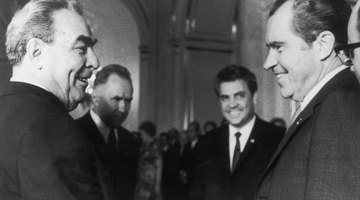
In the 1970s, President Nixon attempted detente, or easing of tensions with the Soviet Union. Nixon visited communist China and engaged in several diplomatic meetings with Soviet leader Leonid Brezhnev in which the two leaders discussed nuclear arms reduction. By the end of the decade, tensions once again escalated as the Soviet Union invaded Afghanistan. When President Reagan took office he denounced the Soviet Union as the "Evil Empire" and dramatically increased military budgets in an attempt to "win" the Cold War.
Thawing Relations
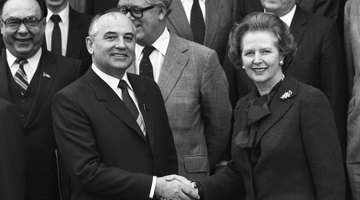
Despite Reagan's bellicose rhetoric, tensions between the two superpowers thawed in the late 1980s. Soviet leader Mikhail Gorbachev adopted friendly relations with the west and instituted liberal domestic reforms through glasnost and perestroika. Reagan, Gorbachev, and British Prime Minister Margaret Thatcher met repeatedly to find common ground as the decade came to a close. In the end, the struggling Soviet economy led to the end of the Cold War. Weakened, the Soviets lost control of much of Eastern Europe by 1990. The fall of the Berlin Wall in November 1989 and the collapse of the Soviet Union in 1991 amounted to the end of the Cold War.
Related Articles





References
Writer Bio
Based in Dallas, Exa von Alt has been working in education and the social sciences for nearly 10 years. Her lesson plans are published on the University of Oklahoma's K20ALT website and she has written several entries in "American Centuries: The Ideas, Issues, and Trends that Made U.S. History"(MTM Publishing). Exa von Alt holds a Master of Arts in history from the University of Illinois at Chicago.