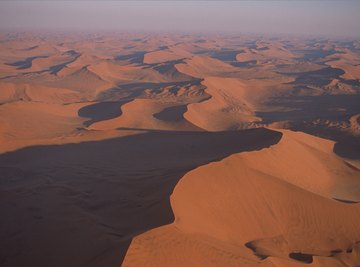

By definition, deserts are land areas receiving less than 25.4 centimeters (ten inches) of rain per year on average. Despite the common perception, temperature does not directly determine whether or not a land area is a desert. Desert weather varies, and deserts can have high, low or mild temperatures. The four subcategories of deserts are: hot and dry deserts, coastal deserts, cold deserts and semiarid deserts. Each type of desert experiences different desert weather, including varying temperatures and amounts of rainfall.
Hot and Dry Desert Temperature and Rainfall
For the most part, hot and dry deserts have high temperatures during the day and low temperatures during the evening. Some of the world's hot and dry deserts have temperatures reaching 49 degrees Celsius (120 degrees Fahrenheit) during the day. Often the desert temperature can fall to as low as negative 18 degrees Celsius (zero degrees Fahrenheit) in the middle of the night.
The dryness of the air in hot deserts helps explain the wide daily temperature swings. Water vapor is an important absorber of heat, but, with low amounts of it in the desert atmosphere, temperatures here are more directly controlled by sunlight: Intense solar radiation heats things up during the day, but once the sun goes down temperatures quickly drop.
Furthermore, the sparse cloud cover in dry deserts means more unobstructed solar radiation in the daytime – translating to higher temperatures – and less reflection of the desert surface’s radiative heat loss at night, which contributes to the colder nighttime temperatures.
Rainfall varies among the world's hot and dry deserts. The Sahara Desert receives as little as 1.5 centimeters (0.6 inches) of rain per year, while rainfall amounts in the American deserts can reach as much as 28 centimeters (11 inches) per year. The Mojave Desert, the Australian Desert and the Atacama Desert of Chile are three examples of hot and dry deserts.
Coastal Desert Weather Patterns
Temperatures in the world's coastal deserts range from 13 to 24 degrees Celsius (55 to 75 degrees Fahrenheit) during the summer. During the winter, temperatures fall to temperatures below five degrees Celsius (41 degrees Fahrenheit). Coastal deserts average between eight and 13 centimeters (three and five inches) of rain each year. Still, some coastal deserts have recorded as much as 37 centimeters (14.5 inches) per year of rainfall.
Coastal deserts include some of the driest areas on Earth – the Atacama Desert in Peru and Chile may go years without actual rainfall – but temperature differences between the ocean and land make fog an important weather phenomenon in some of them. Indeed, coastal deserts such as the Atacama as well as the outer Namib Desert in southwestern Africa are often called “fog deserts,” and receive the bulk of their moisture from this cloudiness.
Cold Desert Climate
Cold deserts are associated with snow during cold winters and rainfall during summers. Cold deserts exist in the Antarctic and the Nearctic realm, an area encompassing the central and northern parts of North America. Annual precipitation in cold deserts generally falls between 15 and 26 centimeters (six and ten inches), on average.
As much as 46 centimeters (18 inches) of rain has been recorded in cold deserts, however. On average, temperatures during the winter months range between negative two and four degrees Celsius (28 and 39 degrees Fahrenheit). During the summer months, temperatures in cold deserts range from 21 to 26 degrees Celsius (69 to 78 degrees Fahrenheit).
Semiarid Desert Weather
Semiarid deserts are the fourth type of deserts found on Earth. Semiarid deserts exist in the state of Montana, in Russia and northern Asia, among other places. Summers in semiarid deserts are long and have average temperatures between 21 and 27 degrees Celsius (69 and 80 degrees Fahrenheit). Temperatures usually stay below 38 degrees Celsius (100 degrees Fahrenheit) in semiarid deserts.
During the evening, temperatures in semiarid deserts drop to around ten degrees Celsius (50 degrees Fahrenheit). Semiarid deserts average between two and four centimeters (0.8 inches and 1.6 inches) of rain per year, on average. In some deserts, more water is created annually from the condensation of dew during the evening than from rainfall.
References
Resources
About the Author
Charles Alex Miller began writing professionally in 2010. He currently writes for various websites, specializing in the sciences. He is a full-time employee in the chemicals and environmental sciences industry.
Photo Credits
Comstock Images/Comstock/Getty Images