

Polygons are mathematical concepts dealing with straight-line geometric figures. Polygons include shapes such as pentagons, hexagons, and octagons. Polygons can be considered convex, concave, or regular. Polygons can share more than one characteristic. For example, a regular pentagon is also considered convex.
Pentagon
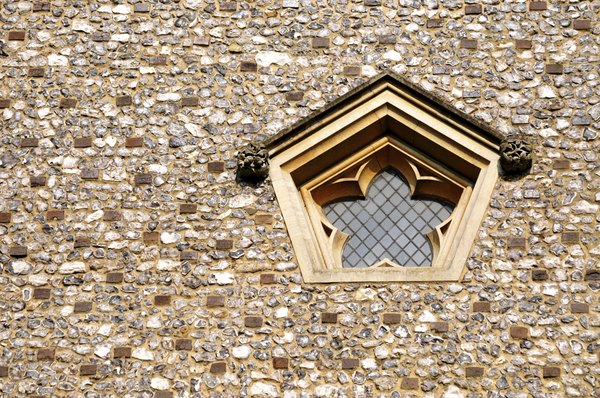
Pentagons are geometric objects with five straight sides. The prefix “penta” comes from the Greek word for “five.” A regular pentagon has five equal sides. To find the area of a regular pentagon, divide the pentagon into five equal triangles. Calculate the area for one triangle and multiply that number by 5. The final answer is the area of the regular pentagon. For example, if the triangle area comes out to 2.1 square inches, multiply that by 5 — the area for the pentagon is 10.5 square inches.
Hexagon

Just as “penta” means “five,” “hexa” comes from the Greek word for “six.” A hexagon is a six-sided polygon. Just as a regular pentagon has five equal sides, a regular hexagon has six equal sides. The area of a hexagon can be found by creating six equal triangles from within the geometric shape. Find the area for one triangle and multiply the number by 6 to calculate the area of the hexagon. If the triangle area is 2.1 square inches, multiply that number by 6 — the area for the entire hexagon is 12.6 square inches.
Octagon

An octagon is an eight-sided figure. The Greek word for “eight” is “okto.” As with the other polygons, a regular octagon has eight equal sides. Breaking the octagon into eight equal triangles allows you to determine the area of the octagon. If the area of one triangle is 2.1 square inches, multiply that number by 8 — the area for the octagon is 16.8 inches square inches.
Examples

Examples of the various polygons are seen in nature, while others are artificial. The Pentagon building is a man-made example of a regular pentagon, while bees use hexagons when forming the hive pattern within the honeycomb. Architects have used the octagon pattern for years when building gazebos. In addition, anyone driving is familiar with the eight-sided stop sign.
References
Photo Credits
Eric Nakano/iStock/Getty Images