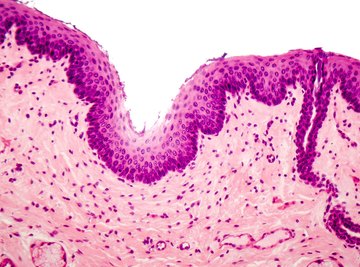

Epithelial tissue is a basic form of animal tissue found in the linings of many structures found throughout the body. They are also integral in forming glands in the body. Epidermis, or skin, is an example of epithelial tissue. There are two different kinds of epithelial tissue, simple and stratified, each which perform different functions and are structured differently.
TL;DR (Too Long; Didn't Read)
Simple tissues are extremely thin -- good for absorption and filtration -- while stratified tissues are thicker, made up of several layers of cells, and offer more protection.
Structure
The biggest difference between simple and stratified tissue is that simple tissue is one layer thick while stratified tissue is multi-layered. All epithelial tissue rests on a basement membrane, which is a thin protective membrane located on the outside of the tissue. Because simple tissue is only one cell thick, every cell in simple tissue comes in direct contact with this basement membrane. Stratified tissue, however, is several layers thick and therefore has layers that do not come in contact with the basement membrane.
Protection
Because stratified tissue consists of several layers of cells, they offer better protection from external threats, such as the filtering in of harmful toxins. Epidermis, or external skin, is an example of stratified tissue. Because skin is vulnerable to damage from outside threats, it contains thick layers of stratified tissue. Some simple tissue is made up of columnar cells, elongated single cells. These offer better protection than normal simple tissue, but not as much as stratified tissue.
Function
Because they are so thin, simple tissue is often found in places where absorption and filtration are necessary. This includes the lining of most of the body's cavities, such as blood vessels, and the lining of a female ovary. Stratified tissue is found where protection is important. For instance, stratified tissue can be found in the lining of the esophagus, as well as the lining of the urethra and bladder.
Cell types
There are three different cell types found in simple epithelial tissue. This includes squamous, the smallest found cells; cuboidal, which are larger cube-shaped cells; and columnar, which are elongated single cells. Stratified tissue contains cells of varying flatness on different layers. Layers farthest away from the basement membrane tend to be the flattest. The layer that touches the basement membrane, however, will contain either squamous, cuboidal or columnar cells.
References
About the Author
Robert Godard began writing in 2007 for various creative blogs and academic publications. He has been featured on multiple film blogs and has worked in the film industry. He attended Baltimore College, earning his B.A. in history.