


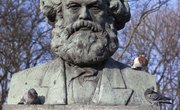
Capitalism and Marxism are competing social, economic and political theories that have dominated the organization of society since the 19th century. Capitalism emerged during the demise of feudalism in the 14th century, and is based on the principle of economic individualism, or the right to own private property and exercise autonomy in making economic decisions. Marxism, oftentimes interchangeable with communism, emerged from the writings of Karl Marx and Fredrick Engels in the 19th century, and is based on the theory that class conflict will eventually result in the establishment of a society where the public owns the means of production. The two theories are historic enemies, and their differences are most acute when examining their attitudes toward individualism, private property and profits.
Individualism
Individualism, which places the rights of the individual above the rights of a collective, is integral to capitalism and is most commonly associated with economic theorist Adam Smith, who posited in the "Wealth of Nations" that the pursuit of a rational self-interest in a market free from regulation would result in economic and social well-being. Karl Marx was influenced by Smith, and, ironically, also espoused the virtues of individual freedom. Marx, however, believed that capitalism dehumanized individuals, especially those in the work force, and that only through communal equality would the individual truly be free.
Private Property
The concept of private property can be traced back to the writings of John Locke who argued that man had a natural right to own what he has produced through his labor. This concept evolved in capitalist theory to mean that ownership of the means of production signifies ownership of what is produced. Marx, in contrast, was devoted to abolishing the concept of private property, which he interpreted as the denial of private property of others. According to the "Communist Manifesto," collective ownership over the means of production and what is produced will result in the emancipation of humanity. For Marx, private property is an expression of man’s relation to the natural world, and the pursuit of it transforms man into an object. When man is freed from private property he is given the freedom to be purely human.
Profit
Capitalism allows for the individual to determine the profit margin derived from the sale of private property in a free market, which was a source of intense criticism from Marx. Marx’s labor theory of value, a foundation stone of Marxian economics and the basis for his criticism of capitalism, equated the value of a product to the number of labor hours needed to produce it. Profits, therefore, could only be derived by capitalists from exploiting the working class. In Marx’s vision for a communist state, reconstructed by Bertell Ollman, an NYU professor of politics, all profits from the previous regime are applied to public purposes and the surplus from production is distributed equally.
Related Articles






References
Writer Bio
Abigail Adams is a freelance researcher and writer. Her work has appeared in "The Jerusalem Report", "eHow", "The Jewish Ledger" and The Motley Fool. She is the founder of the Information Collective, informationcollective.org, a multimedia organization devoted to making academic information accessible. She holds a Bachelor of Arts from the University of Massachusetts in Amherst.