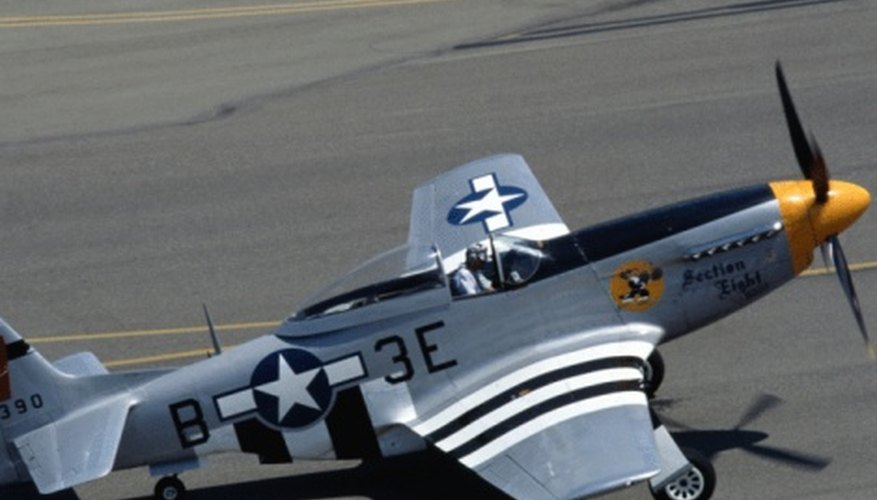

The North American P-51 Mustang, originally produced in 1940, was a high performance fighter aircraft that was instrumental in the Allied victory in World War II. The Mustang performed several different roles exceptionally well, ensuring that it would become one of the most famous and beloved military aircraft of all time.
Development
As the inevitability of war became clear to the British military in 1939, the Royal Air Force asked North American Aviation to design a new fighter, with the requirement that the airplane's prototype be delivered within 120 days. North American took the challenge and produced the aircraft in 117 days. The RAF was so impressed with the prototype Mustang, which significantly outperformed existing British fighters, that it immediately placed an order for 320 of the aircraft.
The P-51D
The United States ordered 310 of its own Mustangs in 1942, and the aircraft underwent a series of modifications, including the employment of a new Packard engine and a teardrop-shaped canopy for increased visibility. The result of the modifications, the P-51D became the most produced variant of the Mustang, with a total of 7,954 aircraft manufactured. The P-51D's bubble canopy, underbelly air intake and graceful rear stabilizer came to epitomize the famous Mustang silhouette.
Performance
The 12-cylinder Allison engine used in the original Mustang produced 1,200 horsepower, allowing the P-51A to achieve a top speed of 390 mph. The P-51A's operational ceiling was 31,350 feet, and it had a range of 350 miles. It was armed with four .50 caliber machine guns and could carry a bomb load of 1,000 pounds. The P-51D utilized a Packard-built Merlin engine that produced 1,695 horsepower and a top speed of 437 mph. The aircraft's ceiling was 41,900 feet, and its range was 950 miles. It was armed with six .50 caliber machine guns and could carry a bomb load of 2,000 pounds or four half-inch rockets.
Roles
The Mustang was a capable fighter, but its speed and agility at low altitude made it an excellent ground support aircraft and escort for Allied bombers. It was the first single-engine Allied aircraft to penetrate Germany from bases in England, and its support was vital in the success of the Allied invasions of Sicily and Italy. During the course of the war, Mustangs shot down or otherwise destroyed 4,950 enemy aircraft. The Mustang would go on to serve in the Korean War, and many of the speedy aircraft were employed as racers well after their military careers were over.
References
Writer Bio
Evan Gillespie grew up working in his family's hardware and home-improvement business and is an experienced gardener. He has been writing on home, garden and design topics since 1996. His work has appeared in the South Bend Tribune, the Fort Wayne Journal-Gazette, Arts Everywhere magazine and many other publications.